Best Anabolic Steroids

Press Enter to search the full catalog.

US Domestic discreet shipping
Third-party batch tested
HPLC & MS verified purity
Trusted Anabolic Manufacturers Only
US Domestic discreet shipping
Third-party batch tested
HPLC & MS verified purity
Trusted Anabolic Manufacturers Only
Back to all products
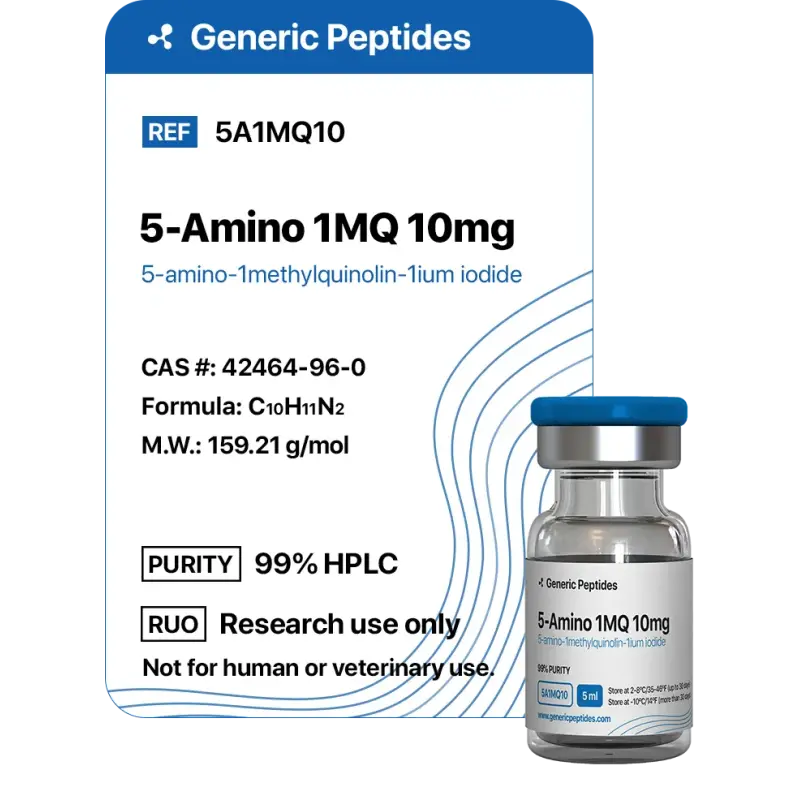
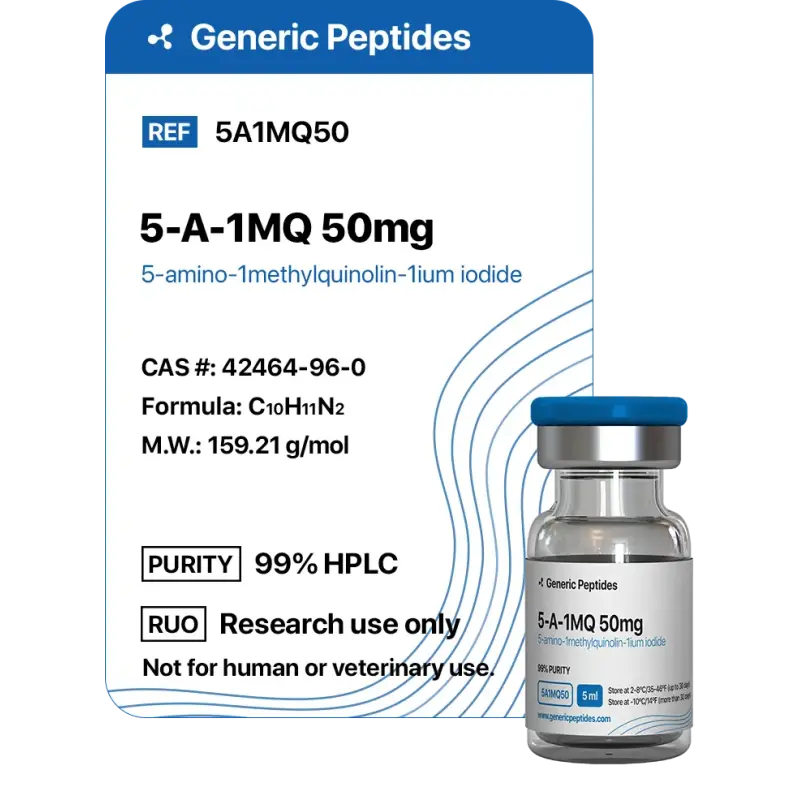
5-Amino-1MQ 10-50 mg Vials - Generic Peptides 5-Amino-1MQ 10-50 mg Vials - Generic Peptides

Generic Peptides

5-Amino-1MQ 10-50 mg Vials - Generic Peptides

Injection · 10 mg · vial

In stock · ships within 24h Out of stock Ships from International
Compound5-Amino-1MQ (5A-1MQ)
ClassSmall molecule, NNMT inhibitor
Half-lifeNo human profile published
Detectionn/a, research product
Liver toxicityNo human data
Water retentionNone described
A small synthetic molecule, not a peptide, offered as 10 mg and 50 mg freeze-dried vials. It blocks the enzyme NNMT, which normally consumes methyl groups from SAM to build 1-MNA; blocking it leaves more SAM and more NAD+ inside the cell and suppresses fat formation in cultured adipocytes. In diet-induced obese mice, daily treatment lowered body weight, white fat mass, adipocyte size and plasma cholesterol without reducing how much the animals ate. No human trial has ever been published, so every quantity on this page is animal work or vendor arithmetic, and the compound has no approval anywhere in the world.
Strength

Not available in this combination

Shipping

Not available in this combination

5-Amino-1MQ 10-50 mg Vials - Generic Peptides
Order Now, Ships Today
$30.00
1
Quality First

All products are manufactured under strict quality standards and independently tested before release. By purchasing, the buyer agrees to use these products in compliance with all applicable laws.

Product Overview

5-Amino-1-methylquinolinium, shortened to 5-Amino-1MQ or 5A-1MQ, is a small synthetic molecule rather than a peptide, although it is shelved among peptides here. Generic Peptides lists it as freeze-dried powder in 10 mg and 50 mg fills. Its target is nicotinamide N-methyltransferase, the enzyme known as NNMT, which transfers a methyl group from SAM onto nicotinamide to make 1-MNA.

Inhibiting that reaction has two consequences inside a cell. More SAM remains available for other methylation work, and more NAD+ stays in circulation because less of it is consumed in the pathway around NNMT. In cultured adipocytes the result is reduced fat formation, and in living mice the published work describes a leaner animal. An observational angle reinforces the interest: NNMT activity correlates with obesity and type 2 diabetes in human tissue studies, which is a correlation and not proof that blocking the enzyme helps anyone.

The compound was characterised in 2018 as a selective inhibitor that leaves related SAM-dependent methyltransferases and NAD+ enzymes alone, and a second study in 2022 repeated the metabolic findings in a different model. That is the whole published base, and all of it is preclinical.

Dosage Protocol

There are no human figures of any kind, so the only quantities that can be written are the animal protocol and the arithmetic of dilution. Neither is a schedule for a person.

Animal reference 32 mg per kg of body weight under the skin each day in the 2022 diet-induced obesity model
Route in models Subcutaneous injection, chosen partly because oral absorption in rodents is poor
10 mg plus 1 ml Reaches 10 mg/ml, where a 10 unit pull carries 1 mg
10 mg plus 2 ml Halves it to 5 mg/ml and a 500 mcg pull at the same mark
50 mg plus 5 ml Returns to 10 mg/ml and a 1 mg pull
50 mg plus 10 ml Returns to 5 mg/ml and a 500 mcg pull, so both fills can be matched
Female No separate protocol is described in any source checked

Bacteriostatic water is run down the inside of the vial and the contents are left to dissolve without shaking. Dry powder keeps cold at 2-8 C, and the made-up solution is also kept at 2-8 C and never frozen; as a small molecule it is generally more robust than a peptide, though the seller publishes nothing specific about solution stability. Because the mouse work dosed daily, the interval between administrations was evidently short, and that is as much as can honestly be inferred about timing in people.

Suggested Protocols

No study has combined this compound with anything else sold here, so the groupings below are shelf comparisons rather than a regimen. They separate the metabolic compounds that work through cellular energy handling, the fat-loss products bought for the same reason, and the redox agent that pairs most naturally on paper.

Cellular energy line
5-Amino-1MQ vial - NNMT inhibition + NAD+ vial + AICAR vial
Two different routes into cellular energy handling, a redox coenzyme and a kinase activator, catalogued side by side because the same buyers ask about all of them
Weight loss shelf
Five products sold for fat reduction with five different mechanisms and five different evidence bases, from an incretin with human data to a kinase activator with none at all
Redox support
5-Amino-1MQ vial + Glutathione vial
The NNMT pathway raises intracellular NAD+, and glutathione belongs to the antioxidant side of the same redox balance; the pairing is a textbook idea rather than a tested combination

What to Expect

  • No human data exist. There are no published clinical trials of this compound in people, which puts it a step behind almost everything else on this shelf.
  • Leaner mice on the same food. In diet-induced obese animals the treatment lowered body mass, white fat mass, adipocyte size and total plasma cholesterol while food intake stayed unchanged.
  • Not an appetite effect. Since the animals ate the same amount, the weight change in the model cannot be explained by eating less, which is the opposite of how an incretin works.
  • A methylation mechanism. Inhibiting NNMT leaves more SAM and more NAD+ inside cells and suppresses lipogenesis in cultured adipocytes, which is the pathway the whole claim rests on.
  • Liver findings in the second model. The 2022 study reported normalised fat mass and liver pathology at a time when diet alone had not produced that result, which is a model observation rather than a human one.
  • Correlation is not causation. Human tissue studies link NNMT activity with obesity and type 2 diabetes, but that does not demonstrate that an inhibitor changes the disease.

Side Effects and Management

With no human study to draw on, the list below is built from the mechanism and from the ordinary risks of an injected research solution. Every row is unconfirmed in people.

Injection site reactionRotate the site and use clean technique; local irritation applies to any injected solution.
Unknown effects of NNMT blockadeTreat long suppression of a methylation enzyme as unstudied and keep exposure short.
Methylation balanceThe pathway consumes SAM, so methyl metabolism is the theoretical point of concern, described in models only.
Poor oral absorptionRodent work used injection for that reason, which is a practical limitation rather than a safety finding.
Long-term profile unknownStop at anything unexplained; nothing has been published on extended use in any species beyond the study windows.

Post-Cycle Therapy

This molecule has no steroidal action at all, so a recovery protocol is not applicable and is not invented here. It does not suppress the gonadal axis, does not raise oestrogen and does not affect sperm production or natural testosterone output.

OnsetThere is no hormonal suppression, so no recovery start date exists
Option ASERM drugs have no deficit to repair after a metabolic research compound
Option BA gonadotropin injection serves no purpose either, since testicular function is untouched
Course shapeAnimal work ran continuous daily dosing for the length of the study; no human block length has been proposed
Follow-upIn the models the tracked items were body composition and plasma lipids, so those are the endpoints a study would look at

Athletes should note the status rather than the chemistry. 5-Amino-1MQ is not named on the prohibited list, but because it is not an approved medicine anywhere it can fall under the general category for non-approved substances, which makes an unlisted status a risk rather than a permission.
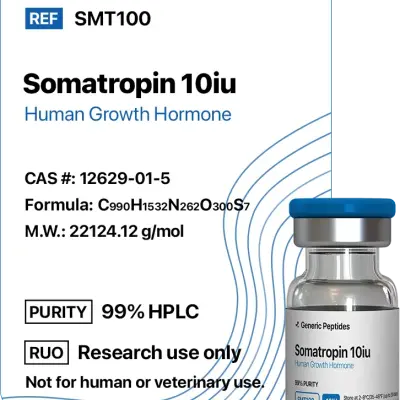
This page is educational and laboratory reference material. The item described is a research compound in lyophilised form and not a medicine; nothing here treats obesity, diabetes, high cholesterol or any other condition. The figures shown come from animal experiments and vendor reference notes and are reproduced so a reader can see that no human data exist at all; they are not a protocol, a recommendation or a prescription, and this is not medical advice. Keep vials out of the reach of children and follow the law where you live.
What is 5-Amino-1MQ and how does it work?
It is a small synthetic molecule that blocks NNMT, the enzyme that moves a methyl group from SAM onto nicotinamide. Blocking it leaves more SAM for other reactions and more NAD+ in the cell, and in cultured fat cells that shift reduces lipid formation. Generic Peptides supplies it as lyophilised powder in 10 mg and 50 mg vials.
Is 5-Amino-1MQ a peptide?
No. It is a quinolinium small molecule with no amino acid chain, so it is not a peptide despite the shelf it sits on. That distinction matters practically: small molecules are usually more stable in solution than peptides, and they can pass cell membranes without the uptake machinery a peptide needs.
What did the mouse studies actually show?
In diet-induced obese mice the treatment reduced body weight, white adipose tissue mass, adipocyte size and total plasma cholesterol, and the animals did not eat less, so the effect was not explained by appetite. The 2022 follow-up used 32 mg per kg daily under the skin and reported normalised fat mass and liver pathology. All of it is mouse work.
Are there human trials of this compound?
None have been published. Human tissue studies show that NNMT activity tracks with obesity and type 2 diabetes, which is a correlation between an enzyme and a disease rather than a treatment result. No phase I safety study, no dose finding and no human outcome data exist for the inhibitor itself.
How do you reconstitute a 10 mg or 50 mg vial?
Bacteriostatic water is added against the vial wall and the powder is left to dissolve. One millilitre in the 10 mg fill gives 10 mg/ml, where a 10 unit pull holds 1 mg; two millilitres halves the strength. Five millilitres in the 50 mg fill restores 10 mg/ml, and ten millilitres halves it again, so either vial can be prepared to match the other. Solution stays cold and is never frozen.
What is the half-life of 5-Amino-1MQ?
No figure can be quoted, because no human pharmacokinetic study exists. The mouse protocols injected the compound every day, which implies a short working interval, but inferring a half-life from a dosing schedule is guesswork rather than measurement and this page will not do it.
Is 5-Amino-1MQ banned in sport?
Not by name, but that is not clearance. The compound has no approval as a medicine in any country, which brings it inside the general category for non-approved substances, so a positive test could still follow its use. Nothing published indicates a specific test for it, which makes detection a separate and unknown question.
Does a metabolic block need any recovery protocol?
No. Nothing that follows an anabolic cycle is relevant here: the molecule does not suppress testosterone production, does not aromatise and does not touch fertility. What would need watching in a human study is metabolic rather than hormonal, in particular body composition and plasma lipids, which were the endpoints used in the animal work.

No reviews yet

Be the first to share your experience with 5-Amino-1MQ 10-50 mg Vials - Generic Peptides

Log in to write a review
5-Amino-1MQ 10-50 mg Vials - Generic Peptides
10 mg · International

Complete the protocol

Stack it with

View all →
Added to cart