Product Overview
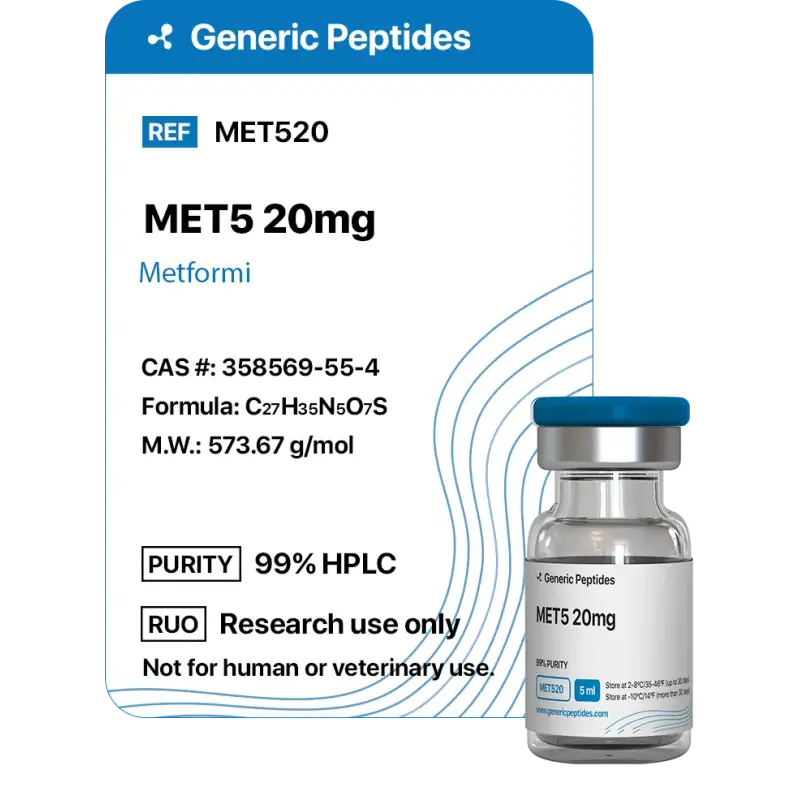
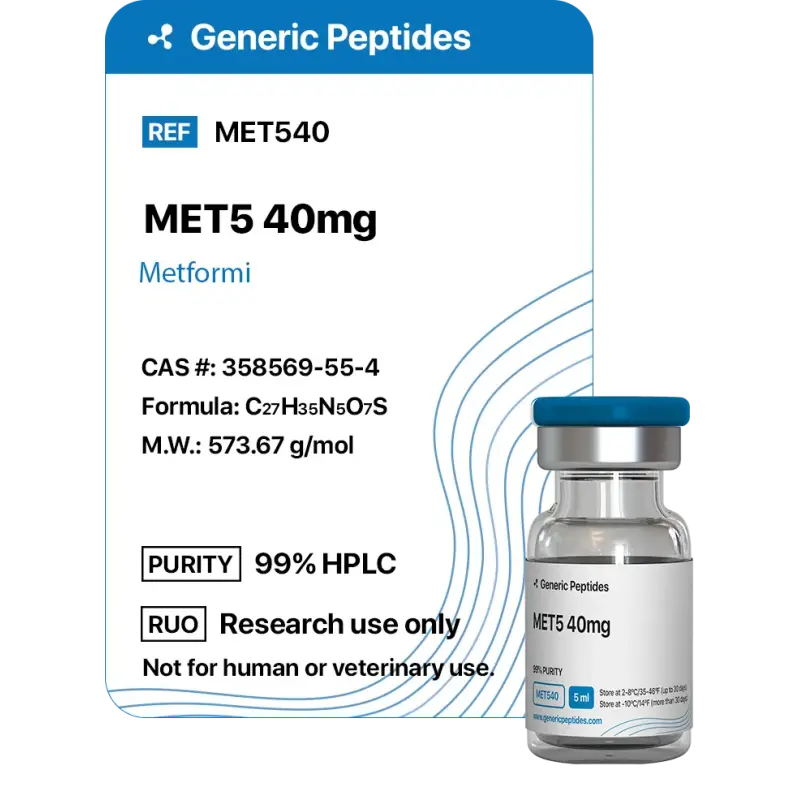
Met-enkephalin, sold here as MET5, is a pentapeptide with the sequence Tyr-Gly-Gly-Phe-Met. It is not a synthetic invention modelled on a natural molecule; it is an exact copy of one of the body's own opioid peptides, found in the brain, in the medulla of the adrenal gland and in immune cells. Generic Peptides lists it as freeze-dried powder in 20 mg and 40 mg vials, and the abbreviation MENK appears alongside MET5 in the literature.
Its receptor preference is unusual for an opioid. It binds the delta opioid receptor strongly, the mu receptor weakly, and barely touches kappa, which in theory separates its profile from morphine-like drugs. That selectivity is the reason it keeps appearing in pain research, even though its practical behaviour in the body is the opposite of convenient.
Two other lines of work surround it. One is immunological: in a 2014 laboratory study, MET5 at a picomolar concentration reduced the proportion of regulatory T cells in human peripheral blood cells and stimulated proliferation of other subsets. The other is oncological and preclinical: a 2016 review proposed the peptide as a candidate for immunotherapy. Neither has been followed by an approved product, and no human dose exists.
Dosage Protocol
There is no human schedule to print, because none has been established. What follows is the reconstitution arithmetic and the description of how research amounts are set, which is by animal body weight or by cell culture concentration rather than by patient dosing.
| Cell studies | Picomolar concentrations in the culture medium, chosen to sit near physiological levels |
| Animal studies | Masses calculated per kilogram of animal weight; no single protocol is shared across the literature |
| Human amounts | None exist; no human dose has ever been established for this peptide |
| 20 mg plus 2 ml | Reaches 10 mg/ml, so 1 mg sits at the 10 unit mark |
| 20 mg plus 4 ml | Drops to 5 mg/ml, where the same pull holds 500 mcg |
| 40 mg plus 4 ml | Identical 10 mg/ml, so the syringe mark again reads 1 mg |
| 40 mg plus 2 ml | Doubles to 20 mg/ml, so 10 units carries 2 mg |
| Female | No separate schedule appears in the sources checked for this peptide |
Bacteriostatic water is used to dissolve the cake, and the solution is kept at 2-8 C, where it is stable for weeks. Freezing is specifically avoided: short peptides lose activity when they are repeatedly frozen and thawed, and this is one of the shortest in the catalogue. The breakdown problem belongs in this section too, because it shapes every protocol. Neutral endopeptidase, aminopeptidase N and dipeptidyl peptidase all attack the chain, and in plasma the half-life is under two minutes, while a reference profile lists a range of 4.2 to 39 minutes. Research therefore uses enzyme inhibitors or modified analogues when it needs the peptide to last.
Suggested Protocols
No experiment has ever paired this peptide with anything else sold here in a controlled design, so the groups below are comparisons a reader can use. They set the neuropeptide line beside it, then the repair compounds and the immune peptides studied in the same immunological literature.
What to Expect
- Pain signalling is the traditional model. Acting through opioid receptors, the peptide damps the release of neurotransmitters along nociceptive pathways, which is the response every opioid shares.
- Delta, not mu. It is a strong delta agonist, weaker at mu and almost inactive at kappa, a selectivity that distinguishes it from morphine-like compounds on paper.
- Minutes, if that. Three peptidases dismantle the chain, and the measured plasma half-life is under two minutes, so nothing about the peptide lasts without chemical protection.
- An immune signal in the dish. The 2014 blood cell study found that a picomolar concentration lowered the regulatory T cell fraction and increased proliferation of other subsets, which is a laboratory result and not a clinical protocol.
- Cancer interest without trials. A 2016 review proposed the peptide for immunotherapy, and no independent Western randomised trial has followed it.
- No product, no dose. An approved medicine based on this sequence does not exist in the United States or the European Union, and it has never been dosed in humans.
Side Effects and Management
The compound has never been given to people in a monitored study, so nothing here is a measured frequency. The rows combine the known class behaviour of opioid receptor agonists with the ordinary events of injecting a peptide.
Post-Cycle Therapy
A post-cycle protocol belongs to compounds that shut down testosterone production, and this peptide is not one of them. It has no steroid structure, does not aromatise and does not act on the gonadal axis at any point.
One regulatory point to close on, because it confuses buyers. The peptide is not named on the prohibited list, yet it has no approval anywhere, which leaves it inside the catch-all class covering substances with no market authorisation. An athlete is therefore in an undecided position, exactly as with the other unapproved neuropeptides on this shelf.