Best Anabolic Steroids

Press Enter to search the full catalog.

US Domestic discreet shipping
Third-party batch tested
HPLC & MS verified purity
Trusted Anabolic Manufacturers Only
US Domestic discreet shipping
Third-party batch tested
HPLC & MS verified purity
Trusted Anabolic Manufacturers Only
Back to all products
Aicar 50mg - Dragon Pharma

Dragon Pharma

Aicar 50mg - Dragon Pharma

Injection · 50 mg · vial

In stock · ships within 24h Out of stock Ships from International · U.S Domestic
CompoundAICAR
ClassAMPK Activator
Half-lifeAbout 1 hour
DetectionWADA S4, banned
Liver toxicityNo human data
Water retentionNone
AICAR is a nucleoside analogue, so it belongs in a research catalogue next to peptides without being one: it carries no ester, no hormone ring and no amino acid chain, and it does not aromatise. The half-life cell rests on clinical acadesine work, where the plasma figure was about an hour, while vendor summaries quote one to two hours and mark the human value for a research-grade material as unconfirmed. Oral uptake is estimated below 5 percent, which is why every research route in the sources is an injection. Supplied by Dragon Pharma.
Shipping

Not available in this combination

Aicar 50mg - Dragon Pharma
Order Now, Ships Today
$65.00
1
Quality First

All products are manufactured under strict quality standards and independently tested before release. By purchasing, the buyer agrees to use these products in compliance with all applicable laws.

Product Overview

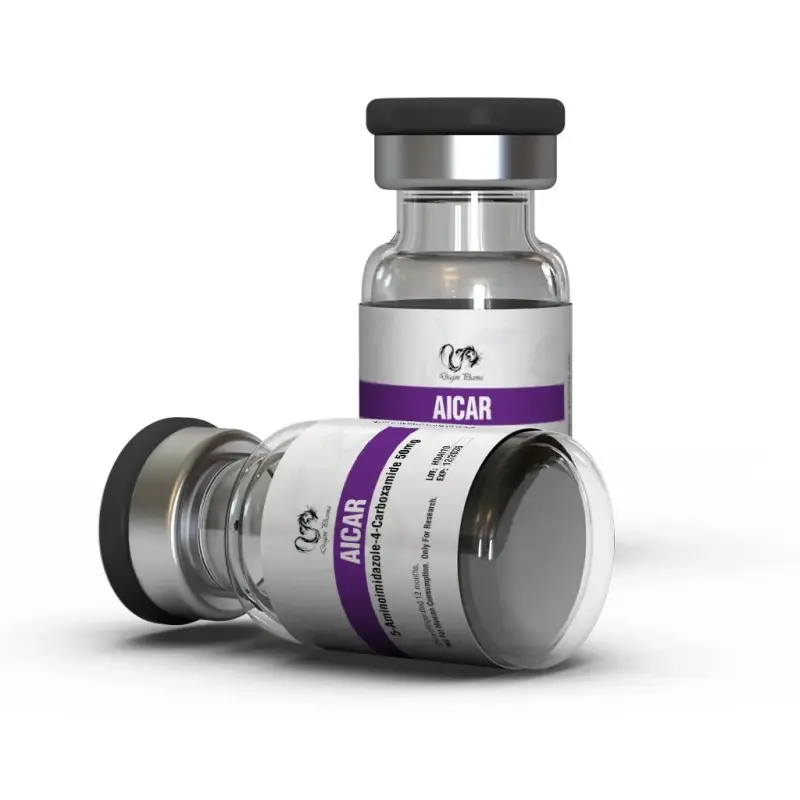
Dragon Pharma Aicar 50mg is a single lyophilised vial of 50 mg of 5-aminoimidazole-4-carboxamide ribonucleotide, a compound better known as AICAR or by its international non-proprietary name, acadesine. The molecule is a nucleoside analogue whose target is AMP activated protein kinase, the switch that reports scarce energy inside a cell; turning it on forces the tissue toward oxidation rather than storage. That mechanism, not an anabolic one, is the reason the material sits in a research catalogue.

Its history is medical rather than athletic. Acadesine was developed from the 1980s as a protectant for heart muscle during ischaemia, carries the ATC code C01EB13, and was also examined in acute lymphoblastic leukaemia. A licence for the cardiac use went to Schering-Plough in 2007, and the phase III programme behind it was halted at the end of 2010 for futility, which is why no approved dose exists to borrow. The compound's second life is laboratory work on metabolism, where mouse experiments at the Salk Institute in 2008 showed better endurance and a shift of fast muscle fibres towards the slower, more oxidative type; the same paper reported that roughly 40 percent of the gene response to training could be reproduced in untrained mice when the compound was combined with GW501516.

Two practical points separate this vial from the peptides on the same shelf. Human oral availability is estimated below 5 percent, so the laboratory route is injection, and the compound is prohibited in sport under the metabolic modulator class, which makes it a controlled item at any tested competition. Neighbours in the same catalogue category include MOTS-c 10 mg and AOD 9604.

Research Dosing Reference

Everything below is arithmetic or an animal figure. No validated human amount exists for this material, and the source notes that the animal dosing was calculated per kilogram of body weight and does not transfer mechanically to a person.

SolventBacteriostatic water into the 50 mg cake; the vial is swirled, not shaken
Concentration at 5 ml50 mg in 5 ml gives 10 mg per ml, so 1 mg equals 0.1 ml, which is 10 units on a U-100 syringe
Concentration at 2 ml50 mg in 2 ml gives 25 mg per ml; 1 mg is 0.04 ml, and small volumes like this call for a low-dead-space syringe
Concentration at 10 ml50 mg in 10 ml gives 5 mg per ml, so 1 mg equals 0.2 ml or 20 units
Animal study amountRodent work scaled the amount to mass: 0.5 mg for every gram of body weight, injected subcutaneously once a day across 14 days; an animal figure, not a human dose
Vendor conventionsPractitioner write-ups quote 1-2 mg a day across a course; the sources label this as practice rather than data
Vial yield50 mg covers 50 days at 1 mg a day and 25 days at 2 mg a day; straight division, not a schedule
FemaleNo female-specific amount appears in any source, and this card does not supply one
RouteSubcutaneous injection; human oral uptake is estimated below 5 percent, which removes the oral option from the discussion

Suggested Protocols

Three groupings show where the vial usually lands next to the rest of the line. Every pill opens the matching product page, and no combination here has been studied as a combination.

Mixing basics
Aicar 50mg - one vial + Bacteriostatic water
The water volume sets the concentration, so 5 ml is the easy reference point and 2 ml is only for low-volume work
Metabolic research shelf
Aicar 50mg - 4-8 week window + MOTS-c 10 mg + SLU-PP-332 + NAD+
All three touch energy handling in laboratory models, and the sources treat any combination as unexplored ground
Fat loss and substrate handling
Aicar 50mg - one vial + AOD 9604 + L-Carnitine 500
These products are grouped in the catalog, not in a publication; the sources record no joint trial of any kind

What to Expect

  • First days. The sources describe nothing beyond a local reaction where the needle goes in; no early subjective effect is documented in people.
  • Weeks 1-2. Users discuss how training loads feel, but that conversation has no clinical data behind it and is treated here as commentary.
  • Weeks 2-4. The observation window vendor guides suggest; the mouse work that first drew attention to the compound ran over the same rough span.
  • Laboratory background. The 2008 endurance and fibre-type findings came from mice, and the compound is studied as a metabolic signal rather than as a fuel or a fat burner.
  • Combination reading. The report of around 40 percent of training genes being activated with GW501516 was a mouse experiment on untrained animals, not a promise of human performance.
  • Limitation. There is no human endurance result for this material at all, and the cardiac programme that could have produced human data was stopped for lack of effect in 2010.
  • Limitation. The compound has been prohibited since 2009, so a positive sample at a tested event is a rules matter with no room for interpretation.

Side Effects and Management

Almost nothing in this list comes from human use of the research material. Most entries are either animal observations, clinical-program signals or simple handling mistakes.

Reaction at the injection siteMove the site each time, keep the procedure clean, discard a cloudy solution. Frequent and confined to the local area.
Episodes of low blood sugar or weaknessThe AMPK mechanism suggests this possibility and user reports mention it: watch how you feel and avoid stacking with fasting. Unconfirmed.
Heart rhythm and blood pressure changesBradycardia and haemodynamic shifts appear in the cardiac programme, where patients were monitored. Described in a clinical setting, so it deserves the same attention.
Lipid and cardiac effects of research useNot examined in the research context at all; the sources suggest tracking lipids, glucose and HbA1c and stopping if symptoms appear.
Heat, flushing or malaise after an injectionUser reports describe it: lower the amount or pause. Reported rather than recorded.
No long-term safety file in humansKeep any research window short and note what changes; the absence of data is the honest headline.
Prohibition and legal exposureBanned since 2009 under the metabolic modulator class, and the compound has no approved status anywhere as a performance product.

Reconstitution, Storage and Follow-Up

Handling is the one part of this file with firm numbers, so it is kept separate from the speculation.
MixingWater is added down the inside wall of the vial and the contents are swirled; shaking is not used
Volume choice5 ml for 10 mg per ml, 2 ml for 25 mg per ml or 10 ml for 5 mg per ml in this 50 mg vial
Dry storage2-8 C for routine holding, a freezer for longer stretches, always away from light
Mixed storage2-8 C with a use-by of roughly 28-30 days, following the vendor rule for lyophilised material
Freezing solutionNot done; the liquid is kept cold rather than frozen
Lab panelGlucose, HbA1c, a lipid panel, ALT and AST plus a full blood count are the markers the sources name for self-observation
Hormonal recoveryAn AMPK activator does not suppress the gonadal axis, so a post-cycle drug protocol has no place in this file
This page is published as an educational and research reference. Aicar is a research-grade compound supplied as a lyophilised powder for laboratory work; it is not an approved medicine, not a fat burner and not a treatment for any condition. Figures quoted above come from animal experiments, a halted clinical programme and vendor practice, and they are printed for information only rather than as a recommendation or a prescription. Nothing here is medical advice. Keep the product out of reach of children and observe the laws and sporting rules that apply to you.
What is AICAR (acadesine)?
AICAR is short for 5-aminoimidazole-4-carboxamide ribonucleotide, also called acadesine or AICA-riboside. It is a nucleoside analogue studied as an activator of AMP activated protein kinase, the enzyme that reports low cellular energy. It was developed as a cardiac protectant, and it is sold today as a laboratory research material rather than a drug.
How does AICAR work?
It switches on AMPK, which cells use as a fuel gauge. Turning that enzyme on mimics part of the metabolic signal that training produces, which is why mouse experiments reported better endurance and a shift in muscle fibre type. The signalling frame is biochemical: nothing about the compound adds muscle tissue or burns fat on its own.
Is AICAR a steroid or a peptide?
Neither. It is a nucleoside analogue, a small molecule with no steroid ring, no ester chain and no sequence of amino acids, and its catalogue neighbours are peptides only by shelf position. It does not aromatise, so estrogen control and water retention are not part of the picture, and it has no effect on the gonadal axis.
AICAR dosage?
There is no validated human amount. The mouse study used 0.5 mg per gram of body weight daily under the skin for 14 days, a figure that does not convert mechanically to a person. Vendor write-ups mention 1-2 mg a day over a course, which the sources themselves flag as practice rather than evidence.
AICAR vs GW501516 vs MOTS-c - what is the difference?
Three different molecules aimed at metabolic signalling. AICAR is a nucleoside analogue that activates AMPK, GW501516 is a synthetic receptor agonist studied for fatty acid oxidation, and MOTS-c is a mitochondrial peptide. The mouse report that combined AICAR with GW501516 is the reason they are often discussed together.
How do you reconstitute Aicar 50 mg?
Add bacteriostatic water along the wall of the vial and swirl it; do not shake. Five ml gives 10 mg per ml, where 1 mg is 10 units on a U-100 syringe, 2 ml gives 25 mg per ml and needs a low-volume syringe, and 10 ml gives 5 mg per ml. Keep the solution at 2-8 C and use it within about 28-30 days.
Is AICAR banned in sport?
Yes. It has been prohibited since 2009 as an AMPK activator inside the metabolic modulator group, and the ban is not limited to competition days. Trace use was part of the questioning around the 2009 Tour de France, and the file records no published urine detection window for the material.
Is Dragon Pharma Aicar legit or counterfeit?
The check is the batch code: confirm it with the brand, compare the vial and carton against official photographs, and ask a seller how a code is verified before ordering. Because this compound is a plain white lyophilised powder, appearance alone proves nothing, and a price far below the rest of the line is a poor sign.

No reviews yet

Be the first to share your experience with Aicar 50mg - Dragon Pharma

Log in to write a review
Aicar 50mg - Dragon Pharma
International

Complete the protocol

Stack it with

View all →
Added to cart