Product Overview
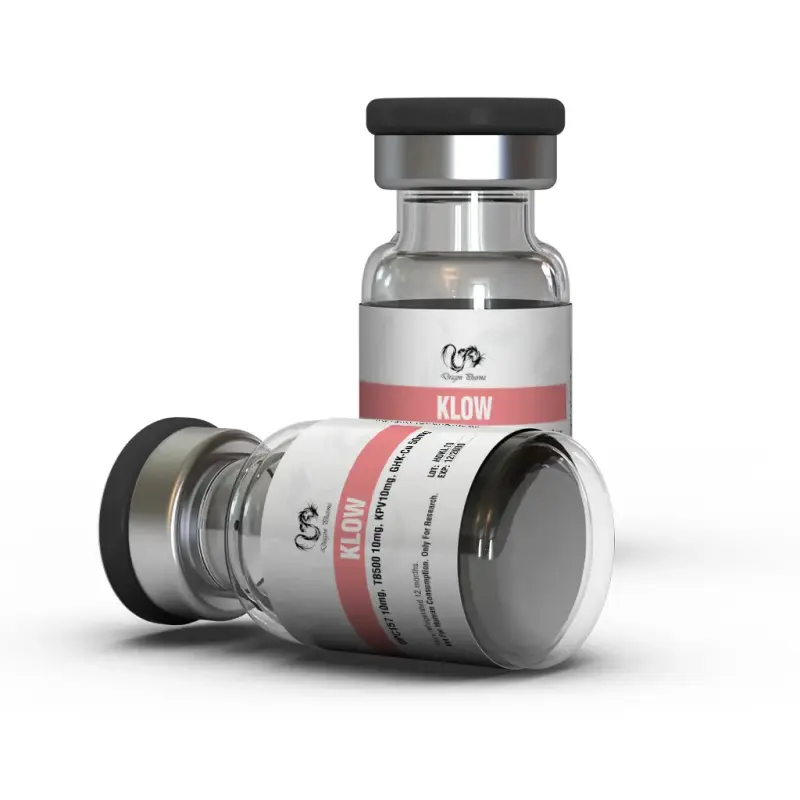
Dragon Pharma Klow Blend is one freeze-dried vial that holds 80 mg of material split across four repair-oriented peptides: BPC-157, TB-500, KPV and GHK-Cu. BPC-157 is a pentadecapeptide, a fifteen amino acid chain that comes from a gastric protein. TB-500 is the research name for the acetylated heptapeptide sequence Ac-LKKTETQ, a fragment of the protein thymosin beta-4. KPV is the three residue tail of alpha-melanocyte stimulating hormone, built from lysine, proline and valine, and much of the anti-inflammatory activity credited to that hormone has been attributed to this short piece; the literature describes it as an inhibitor of the NF-kB pathway. GHK-Cu is a copper complex built on the tripeptide glycyl-histidyl-lysine. They share the 80 mg cake because each covers a different part of one repair job - connective tissue and skin from BPC-157 and GHK-Cu, a structural fragment from TB-500, and the inflammatory arm KPV adds - so none of the four substitutes for another.
The market version of the three-peptide combination runs a typical ratio of 5:1:1 for GHK-Cu, BPC-157 and TB-500, and the catalog usually calls it the Glow blend. Adding KPV is what turns that grouping into Klow, and the fill grows from 60 mg to the 80 mg in this vial. The exact weight of each peptide is printed on the label, and nothing here should be read as a way of splitting the four apart. Buyers who prefer the individual components can order BPC 157 2 mg, TB 500 5 mg, GHK-CU 10 mg and the two-peptide BPC-157 / TB-500 blend.
Interest in these peptides rests on tissue repair, connective tissue and skin work, and on the inflammatory arm that KPV adds. The honest frame still applies: the four-component mixture has never been through a clinical study, and KPV is the least documented of the four. The vial inherits the uncertainty of all four rather than averaging it away.
Research Dosing Reference
The rows below gather the figures the sources actually print. They come from vendor conventions, community write-ups and animal work, never from a controlled human trial of this mixture, and the four peptides inside one vial cannot be dosed separately.
| Reconstitution | Bacteriostatic water into the 80 mg cake; 4 ml gives 20 mg per ml of total peptide, 8 ml gives 10 mg per ml |
| Syringe scale | U-100, where 0.1 ml equals 10 units: at 20 mg per ml a 2 mg draw is 10 units, at 10 mg per ml the same 2 mg needs 20 units |
| BPC-157 component | 150-375 mcg twice a day, taken from a review of user protocols and not from controlled human data |
| TB-500 component | Loading of about 2.5 mg given twice weekly across 4-6 weeks, followed by a 2.5 mg weekly top-up in vendor protocols |
| GHK-Cu component | 1-2 mg a day in systemic preclinical models; the human skin work on this peptide was topical and used a cream or serum |
| KPV component | No human amount appears anywhere in the sources; only the NF-kB mechanism is documented |
| Blend total | 1-2 mg a day over 4-8 week courses is an extrapolation from the single-peptide figures, not a study result |
| Vial arithmetic | 80 mg of fill lasts 80 days at 1 mg a day and 40 days at 2 mg a day; this is arithmetic, not a schedule |
| Female | No confirmed protocol for this blend exists in the sources, and none is constructed here |
| Administration | Subcutaneous injection; the described action is systemic, so the needle is not aimed at the injured tissue itself |
Suggested Protocols
Three groupings show how this vial is placed next to the rest of the line. Each pill opens the matching Dragon Pharma page, and the diluent in every case is the preserved water.
What to Expect
- First days. The only event the sources support is a local reaction where the needle went in; no systemic effect is expected in the opening days.
- Weeks 1-2. Users with ligament and tendon problems describe less pain. Those are user reports, and clinical evidence for the claim does not exist.
- Weeks 2-4. Forum write-ups talk about easier movement and better tolerance of training load; nothing in the published material measures that.
- Weeks 4-8. The usual length given for a course of this blend, while TB-500 on its own is described with a loading stage of 4-6 weeks.
- Skin angle. GHK-Cu has been examined mostly in cell culture and on the skin surface, where fibroblast collagen production was reported; a 2018 human study applied it topically for 12 weeks.
- Limitation. WADA names BPC-157 in class S0 and thymosin beta-4 derivatives, TB-500 included, in class S2, both permanently, and injectable TB-500 has never been tested in people.
- Limitation. A theoretical discussion links BPC-157 with angiogenesis, and the sources treat that as a question still open rather than a settled risk.
Side Effects and Management
None of the entries below comes from a trial of this four-peptide vial. They are component-level observations and handling mistakes, and the dose-dependence of most of them is unknown.
Reconstitution and Handling
The properties of the powder are the best documented part of this offer, so the rows below list what the sources state and where they stop.