Product Overview
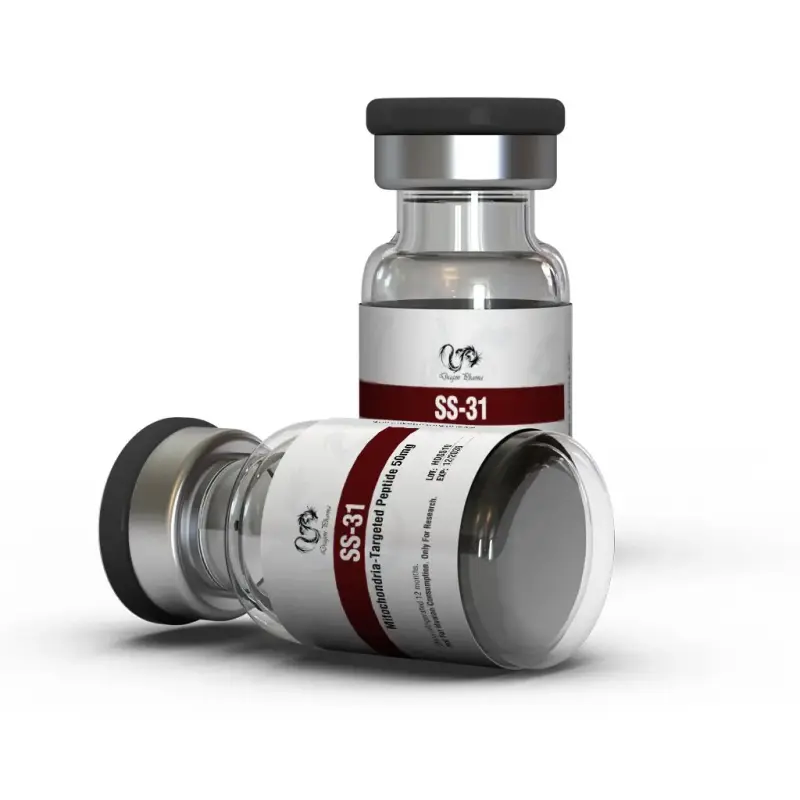
This card covers a 50 mg lyophilised vial, supplied as research-grade powder with no solvent included. The active material is elamipretide, also catalogued as SS-31 and MTP-131, a tetrapeptide with the sequence D-Arg-Dmt-Lys-Phe-NH2. Its target is cardiolipin, a phospholipid that sits on the inner mitochondrial membrane, and that binding is described as the reason it concentrates where energy production happens instead of circulating broadly.
The regulatory position needs to be stated carefully, because a headline about approval is easy to misread. In September 2025 the FDA granted accelerated approval for Barth syndrome, a rare genetic condition, making elamipretide the first treatment for that disease; the decision leaned on knee extensor strength as an intermediate endpoint and carries a requirement for a confirmatory trial. Patients weighing at least 30 kg receive 40 mg subcutaneously once daily. The licensed presentation is a single-patient-use solution of 280 mg in 3.5 ml, which is 80 mg per ml. A 50 mg lyophilised vial is a different object with a different strength and a different storage life, and the two are not interchangeable at the bench.
The label pharmacokinetics are the only human numbers available. After a subcutaneous dose the peak arrives within 0.5 to 1 hour, absolute bioavailability is about 92 percent, volume of distribution is roughly 0.5 L per kg, and close to 100 percent of the dose is recovered in urine by 48 hours. No terminal half-life is published. The often repeated figure of 1 to 2 hours comes from secondary summaries rather than the label, so it is repeated here as unconfirmed. Nearby research material includes MOTS-c 10mg and NAD+, mitochondrial in theme but different in target and status. Handling follows the same discipline as the growth-axis powders in this section, such as Dragontropin HGH and Ipamorelin 5mg.
Reconstitution and Research Amounts
Two things are kept apart in the table. The dilution lines are arithmetic that any user can check, while the milligram amounts come from vendor protocols with no trial or regulatory basis behind them.
| Solvent | Let bacteriostatic water run down the glass wall; the lyophilised cake is left alone rather than stirred |
| 50 mg in 2 ml | Twenty-five milligrams per millilitre, which makes a milligram only four hundredths of a millilitre and demands a low-volume syringe |
| 50 mg in 5 ml | Ten mg per ml; a milligram measures 0.1 ml, ten units on a U-100 scale |
| 50 mg in 10 ml | Five mg per ml; a milligram measures 0.2 ml, or twenty units |
| Approved reference dose | 40 mg subcutaneously once daily for Barth syndrome patients of at least 30 kg; the label reduces the dose in severe renal impairment |
| Research amounts reported | 1-5 mg a day subcutaneously in 4-12 week blocks; vendor convention with no regulatory or trial basis |
| Vial arithmetic | 50 mg at 2 mg a day lasts 25 days; at 5 mg a day it lasts 10 days |
| Female | No female amounts appear anywhere in the material assembled for this card, so the row carries nothing |
Storage differs by object. The approved solution is kept at 2-8 C and must not be frozen, and an opened vial is discarded eight days after first opening. For a research lyophilisate the convention is 2-8 C protected from light, with a freezer for long-term storage, while a mixed solution is treated as a short-lived item with weeks rather than months of life; the vendor window is not confirmed for this specific vial.
Mitochondrial Combinations
The combinations below are catalogue arrangements with shared themes, not tested protocols; no source describes elamipretide being given with any of them.
What to Expect
- Day 1-3. Injection site reactions are the leading adverse event in the clinical programme: redness, pain, hardness under the skin, itching, bruising and hives. No systemic change is documented in the first days.
- Weeks 1-2. User reports turn to energy and exercise tolerance, but in healthy people there is no controlled evidence yet, because the first dedicated healthy-aging study was still recruiting in late 2025.
- Weeks 4-8. The window most vendor protocols describe, inside the 4-12 week range.
- Barth syndrome story. In the open-label extension of TAZPOWER, walking distance on the six-minute test improved cumulatively by 96.1 m at week 168, with fatigue scores also better; injection site reactions remained the most common complaint.
- The harder part of that record. The randomised crossover stage, 12 subjects at 40 mg a day, met neither primary endpoint, and the gain appeared later in open-label treatment at 36 weeks, plus 95.9 m.
- Where it failed. In primary mitochondrial myopathy the phase 3 MMPOWER-3 study, 218 subjects, was stopped without improving the six-minute walk test or the fatigue score; only a prespecified subgroup with nuclear DNA variants improved.
- Limit. Small trials in rare disease do not transfer to healthy users chasing energy or longevity.
Side Effects and Management
Tolerability data come from Barth syndrome patients, a narrower group than the people who buy a research vial.
Monitoring, Storage and No PCT
This peptide does not suppress the androgen axis and no SERM step applies. The moving parts are the vial itself, the kidneys and the absence of validated markers.