Product Overview
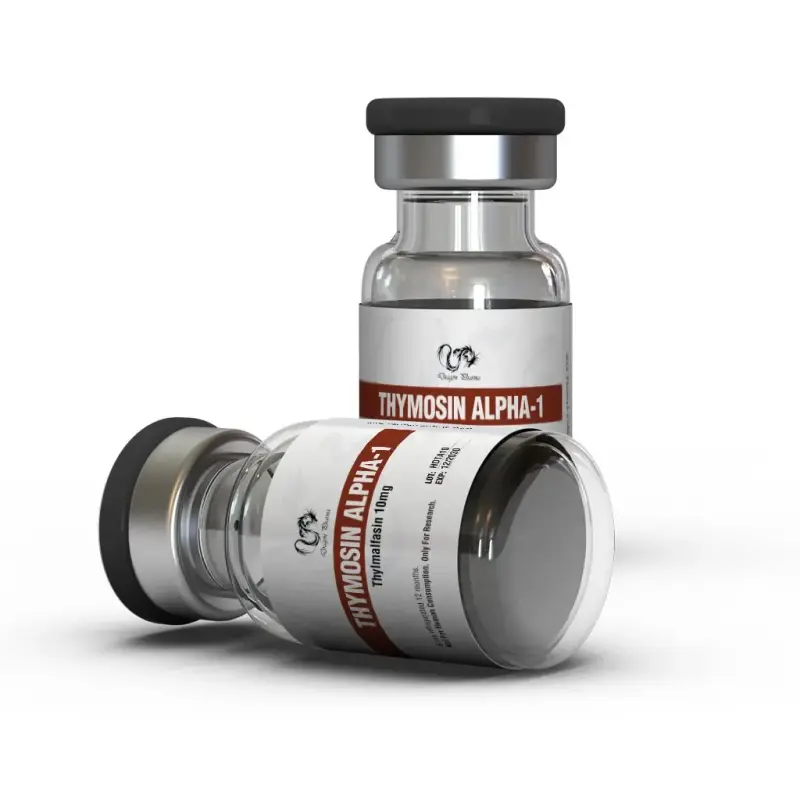
Dragon Pharma Thymosin Alpha-1 is a lyophilised 10 mg vial of a synthetic 28 amino acid peptide that copies a hormone found in the thymus. The history starts in 1977, when the peptide was isolated from thymosin fraction 5 and described in PNAS, and it continues today outside the United States, where an approved form has been registered in several countries for chronic hepatitis B and C. The international nonproprietary name for the synthetic molecule is thymalfasin, and one of its trade names is Zadaxin.
The classification that fits it best is biological response modifier. Rather than acting on a single receptor with one downstream effect, it shifts the cellular side of immunity: it strengthens the T-cell response, influences the maturation and function of T-lymphocytes and changes cytokine production. Animal work supplies the classic proof-of-concept, because the peptide restored immune function in animals without a thymus. That is a clean experimental result and it is still a long way from a claim about anyone's health, which is why this vial is presented as a research product. The line-up around it is thematic rather than mechanistic, with other research materials such as TB 500 and Epitalon sharing shelf space but not a study.
Vial Arithmetic and Reconstitution
Dissolve the powder by running bacteriostatic water slowly down the inside of the glass and swirling the vial; shaking is avoided because it foams the solution. Clinical labels work at 2 mg per ml, a strength a 10 mg vial reaches with 5 ml of diluent.
| Vial plus diluent | 10 mg + 5 ml settles at a strength of 2 mg per ml, the working figure seen on clinical labels |
| Same strength elsewhere | 2 mg + 1 ml, or 5 mg + 2.5 ml, or 15 mg + 5 ml come to much the same figure, with the last one a little stronger at 3 mg per ml |
| What a 0.1 ml draw contains | 200 mcg of peptide, charting as the 10 unit line; the 1.6 mg clinical amount occupies 0.8 ml |
| Clinical reference dose | 1.6 mg subcutaneously twice weekly over about 12 weeks, the labelled scheme for hepatitis B |
| Spread across clinical work | Single amounts between 0.8 mg and 6.4 mg subcutaneously twice weekly; a range observed in studies, not a recommendation |
| Vial duration | Six injections of 1.6 mg come out of a 10 mg vial, which is 3 weeks of twice-weekly work |
Those numbers come from clinical practice documented for the substance, and their purpose here is to make the arithmetic of the vial legible. They are not a treatment plan, and the fact base repeats that framing.
Clinical Reference Points
The research directions documented for the peptide are chronic viral infection, including hepatitis B and C, sepsis, respiratory infection in severely ill patients and immune support during cancer treatment. That list says where scientists have looked, not what the peptide achieves, and the honest part of the record is included below rather than left out.
The clearest negative result is a 2023 review of hospitalised COVID-19 patients, which found no reduction in mortality and no shortening of hospital stay with thymosin alpha-1. Separately, the schedule that recurs across clinical work is subcutaneous injection twice a week over a defined block. Anyone comparing this vial with the rest of the shelf should take the comparison as topic-based, since no study has combined it with other products in this line.
What to Expect
- T-cell direction. The record describes enhanced cellular immunity, effects on T-lymphocyte maturation and function, and changes in cytokine production. This is the mechanism, and it is measured in immune assays rather than felt.
- Predictable kinetics. After a 900 mcg subcutaneous injection the peak comes at 1 to 2 hours and the half-life is 2 to 3 hours, which is actual human pharmacokinetic data.
- Twice-weekly rhythm. Clinical schemes use two injections a week, so the intent is background support over a block rather than something felt after one dose.
- Animal proof-of-concept. In animals without a thymus the peptide restored immune function, which is the foundation of its immunomodulatory use.
- Limitation. The COVID-19 review in hospitalised patients showed no mortality or hospital-stay benefit, so expectations should not run ahead of that result.
- Limitation. There is no US registration; this vial is a research product and not a prescription medicine.
- Limitation. The peptide is not named in the WADA Prohibited List, which is an absence of a rule and not the same thing as permission.
Side Effects and Management
Reported effects are mild and mostly unspecific, but one category deserves attention before anything else: a molecule that pushes the immune response needs a second look in anyone with an autoimmune history.
Immune Monitoring, Storage and No PCT
There is nothing to recover after this peptide, because it never touches the gonadal axis. Storage and a written observation log matter more than any recovery step, and the notes below are the ones that follow from the sources.