Product Overview
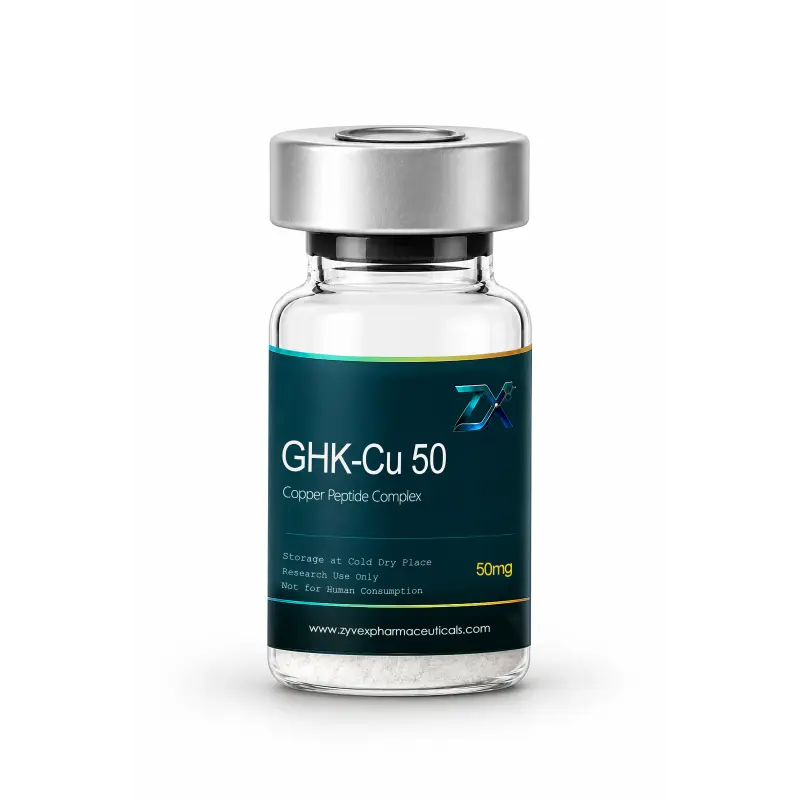
Zyvex Pharmaceuticals ships GHK-CU 50 through Best Anabolic Steroids as one vial of lyophilised powder for reconstitution. The active substance is GHK-Cu, a tripeptide with a single copper ion bound to it, sometimes catalogued as copper tripeptide-1. It is not a synthetic invention in the usual sense: the peptide is a natural component of human plasma and is found in saliva and urine as well, which is why the research around it is written in the language of physiology rather than of doping.
The work that made it interesting is about connective tissue. In fibroblast cultures and in animal models the peptide is associated with increased collagen synthesis, more glycosaminoglycans and a calmer inflammatory response, and wound studies describe faster closure and contraction. Those findings are real, and they are also entirely preclinical. Human elimination has never been measured, no validated human schedule exists, and the sources state that human pharmacokinetics are unestablished. The number that appears in protocols, 1 to 2 mg per day, is a research anchor taken from models.
Buyers come to it for skin, hair and connective tissue, which puts it on the same shelf as the other repair materials rather than with anything hormonal. Its usual companions are BPC 157 for local tissue work and TB-500 for the systemic side of the same project, and a quiet training programme can sit behind all three. Because the target is structural rather than androgenic, none of them requires an anti-estrogen or a recovery drug at the end.
How the Copper Peptide Works
The copper is the whole point of the molecule. GHK on its own binds the metal in a fixed 1:1 ratio, and the complex is what the literature studies. In cell work the peptide is linked to the production of collagen and of the ground substance between cells, and in animal models to faster wound closure; both are consistent with a signal that tells connective tissue to rebuild rather than with a hormone that tells muscle to grow.
What is missing is the human half of the file. Elimination has not been established in people, so there is no way to compute an interval from a half-life, and the sources say so instead of providing a number. The same gap applies to route: almost all of the data come from models and from topical application, and no human data describe subcutaneous use of this peptide at all. That distinction matters when a dose table is read as though it were clinical.
Sporting status is equally incomplete but in the other direction. A search of the WADA list finds no entry for GHK-Cu, and the sources report that no official prohibition could be located. That finding is not a permission slip, and any athlete should treat an unlisted research peptide as their own risk rather than as a cleared substance.
Dosage Protocol
There is no approved dose and no confirmed human schedule for this peptide. The row below marks the only quantity that appears in the research literature, and it is a model figure.
| Level | Amount | Length | Notes |
|---|---|---|---|
| Research anchor | 1-2 mg daily | defined by the study | The systemic figure used in models; not a human dose and not a schedule anyone has validated |
| Typical approach | Short courses | short blocks | Community practice runs the peptide for a short block and then pauses; no confirmed duration exists |
| Female | No separate schedule | - | Nothing in the sources distinguishes female from male use, because no human schedule exists for either |
| Route in the literature | Topical or model-based | - | Most published work is local application; human subcutaneous data are absent |
| Administration | Reconstituted vial | as calculated | The amount drawn depends on the volume of solvent added, not on the nominal fill |
Anyone reading the 1 to 2 mg row as a starting dose should read the next paragraph too. It is the amount that produced effects in laboratory work, and laboratory work is where the entire evidence base sits.
Suggested Protocols
These are catalogue shapes rather than tested combinations. Nothing in the sources describes GHK-Cu being studied together with any of the partners below.
What to Expect
- Timelines for people are absent. Healing and contraction are described in models; no schedule of expected change in a person taking this peptide has been published, so a week-by-week answer would be invention.
- Collagen and ground substance. Fibroblast work describes more collagen synthesis and more glycosaminoglycans, and reviews describe an anti-inflammatory effect. Training alongside it changes skin and joints far more slowly than these cell studies imply.
- Nothing hormonal. The peptide leaves testosterone, estrogen and gonadotropins untouched, so blood work will not report anything about the course.
- Route mismatch. Most published work is topical or model-based and no human subcutaneous data exist, which means an injectable course runs further from the evidence than the same peptide applied to skin.
- The limit. Research grade material, no approval anywhere, sterility and dosing entirely with the user, and a genuine skin or joint problem needs a clinician.
- Testing. No WADA entry was found for GHK-Cu, but an absent listing is not a clearance, so a tested athlete has to make that call knowingly.
Side Effects and Management
Reconstitution and Storage
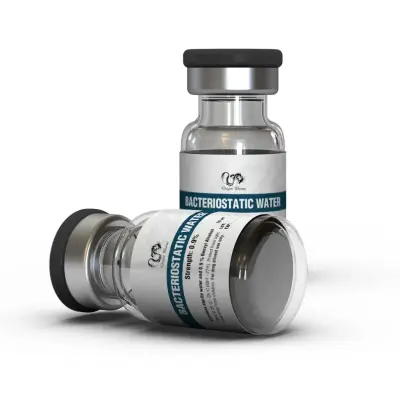
The 50 mg vial is dissolved with bacteriostatic water. Vendor guides put the working range at 2 to 5 ml of solvent, which gives roughly 10 to 25 mg per ml, and the amount drawn afterwards is calculated from that concentration. A mixed solution of a copper complex does not look like plain water, and the colour comes from the metal at the centre of the peptide; reconstitution guides remark on it, and it is not a sign that the material has spoiled.
| Stage | Condition | Practical notes |
|---|---|---|
| Powder before mixing | Cold storage | Keep the sealed vial cold and out of light; do not freeze it |
| After mixing | Refrigerated | The solution belongs in the refrigerator; the exact shelf life of this vial is not confirmed in the sources |
| Concentration | Set by the solvent volume | 2-5 ml into the 50 mg fill gives about 10-25 mg per ml, and every later amount is read from that figure |
| Handling | Sterile technique | Swab the stopper, one needle per draw, and no returning liquid from a syringe into the vial |
Buying GHK-CU 50 by Zyvex Pharmaceuticals
The vial is listed inside the Zyvex Pharmaceuticals range as a single 50 mg lyophilised fill with the mixing figures recorded on the card. Buyers usually take it as part of a repair order together with BPC 157 or TB-500, and the conditioning products that often sit in the background of those blocks are Cardarine GW-501516 and Ostarine MK 2866. Checkout shows the destinations and payment routes that apply to you, parcels leave in plain outer packaging, and queries about the fill size or the water volume are answered before anything is dispatched.