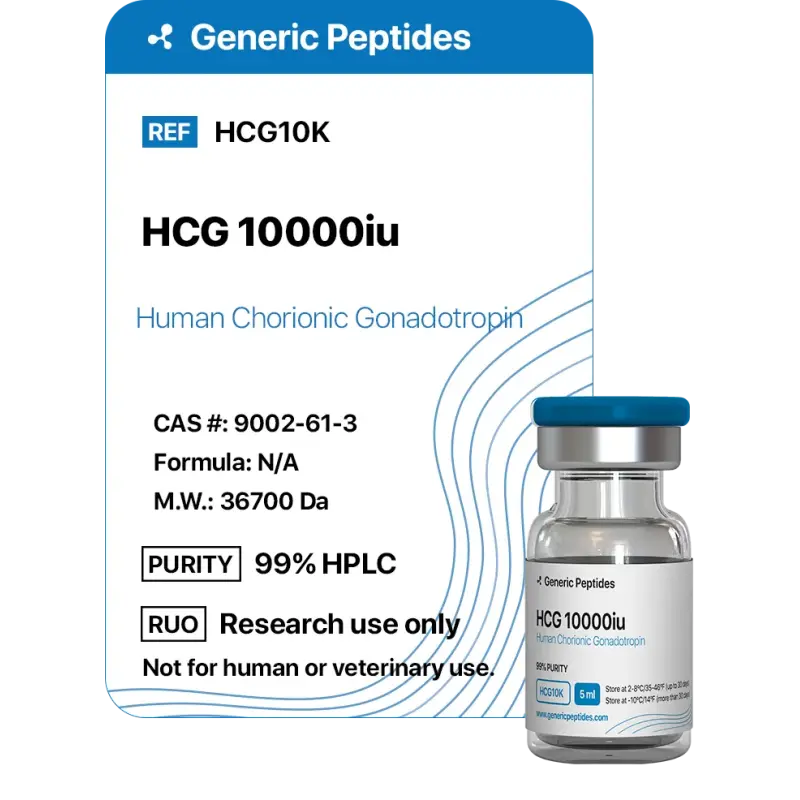
Product Overview
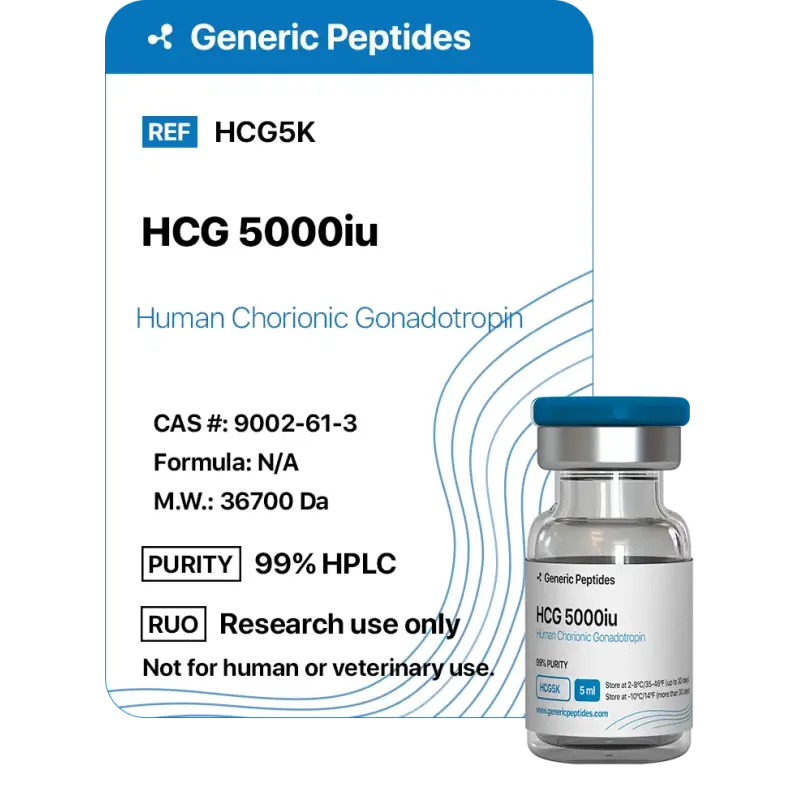
Human chorionic gonadotropin is a glycoprotein built from two chains, an alpha subunit of 92 amino acids and a beta subunit of 145, produced naturally by the placenta. Generic Peptides offers it as 5000 IU and 10000 IU vials of lyophilised powder. Its clinical uses are fertility related, but the reason it sells in this catalogue is narrower and easier to state: it behaves like luteinising hormone at the testis.
The luteinising hormone receptor sits on the Leydig cells, and when it is stimulated those cells produce testosterone. During a suppressive steroid course the pituitary stops sending its own signal, the testes shrink and their output falls. hCG supplies an external signal through the same receptor, so testicular volume and local testosterone production are maintained even while the natural drive is switched off.
That substitution is also the boundary of what the hormone can do. It does not restore the pituitary feedback loop, and stopping it leaves the axis exactly as suppressed as the underlying course made it. This is why hCG is described as support during or at the end of a cycle rather than as a recovery drug, and why the tablets that restart pituitary signalling still have a job afterwards.
Dosage Protocol
The amounts used in practice sit far below the fertility doses on the clinical label, because the aim here is testicular support rather than ovulation or spermatogenesis. The table gives the range and the arithmetic needed to measure it.
| Starting amount | 250 IU on alternate days, or 500 IU twice or three times weekly, across 4-8 weeks |
| Typical block | 500 IU two to three times a week, or 500-1000 IU on alternate days, for 2-4 weeks |
| End-of-cycle use | 500-1000 IU on alternate days for roughly 10-16 days, then a SERM plan begins |
| Upper range | 1000-3000 IU up to three times a week in short blocks, with estradiol monitored |
| Route | Subcutaneous or intramuscular; testosterone rises within a day of the injection |
| 5000 IU plus 5 ml | Gives 1000 IU/ml, so 25 units on a U-100 syringe is 250 IU |
| 5000 IU plus 2 ml | Gives 2500 IU/ml, so 10 units is 250 IU and 20 units is 500 IU |
| 10000 IU plus 10 ml | Gives 1000 IU/ml, the same working strength as the diluted 5000 IU vial |
| Female | No bodybuilding protocol is described; in medicine the hormone is used for ovulation induction under supervision |
Bacteriostatic water is used to dissolve the powder. The dry vial keeps cold at 2-8 C, and the labels allow room temperature storage away from light; the mixed solution belongs in the fridge only, must never be frozen, and stays usable for about 30 days in one manufacturer's instructions and up to 60 in another. For anyone who wants a clinical reference point, the label for hypogonadotropic hypogonadism in men describes 500-1000 USP units three times a week for three weeks, then the same amount twice a week for three more weeks, with an alternative long schedule of 4000 units three times weekly for six to nine months.
Suggested Protocols
hCG is not stacked with anything in the sense of pairing compounds for effect; it is placed at a point in a calendar. The three arrangements below are the shapes described in the sources, followed by the related gonadotropins sold in the same catalogue section.
What to Expect
- Testicular volume returns first. A visible change in size is usually noticed within one to two weeks of starting support during a suppressive course.
- Testosterone rises within a day. The injection produces a measurable increase in serum testosterone inside 24 hours, which is the fastest signal the compound gives.
- Wellbeing and libido follow in one to two weeks. These are slower than the hormone change itself and are the response users most often describe.
- Estradiol can climb. More testosterone inside the testis means more aromatisation, and at higher amounts that appears as water retention and breast sensitivity.
- Leydig cell desensitisation is the dose ceiling. Continuous high amounts can blunt the cells' response, which is why the literature favours short blocks.
- It does not switch the axis back on. When the last injection is metabolised, pituitary signalling is still suppressed and a SERM plan is what restarts it.
Side Effects and Management
hCG is a well characterised prescription hormone, so the events below are known class effects rather than speculation. Most of them trace back to the rise in testosterone and the oestrogen it converts into.
Post-Cycle Therapy
This is the one card in this group where a recovery protocol is genuinely required, because hCG itself is not recovery. It mimics luteinising hormone, so the pituitary remains quiet while it is in use, and the tablets that provoke the pituitary still have to do their work afterwards.
Two practical reminders belong here. Estradiol should be watched throughout any hCG use, because the hormone raises testicular testosterone and therefore aromatisation. And in sport, urine testing detects hCG immunologically for seven to ten days after administration with a threshold around 5 IU per litre, so the timing of use is visible to a laboratory, not only to a calendar.