Product Overview
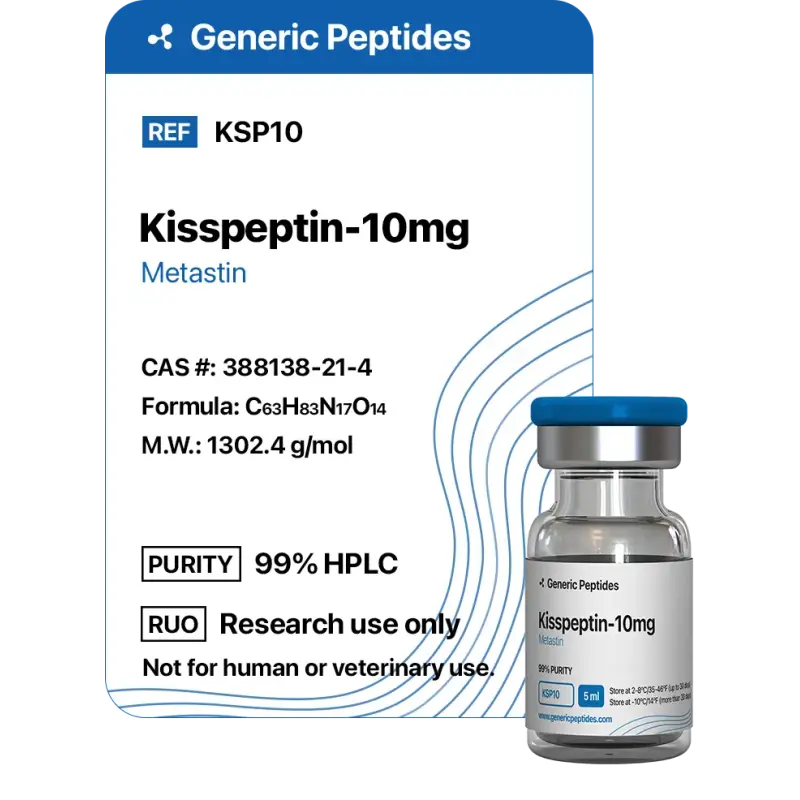
Generic Peptides supplies this compound as a freeze-dried 10 mg vial. The substance is kisspeptin-10, the shortest active fragment of a peptide family whose human full-length member runs to 54 amino acids. Its second name, metastin, is a leftover from the discovery biology: the KISS1 gene was first characterised as a suppressor of metastasis, so the protein it encodes was named for that role before its reproductive function was understood.
Chemically it belongs to the RF-amide group, whose members end in a conserved ten residue tail. It is the natural ligand for the receptor once called GPR54, now written Kiss1R, and that receptor sits on GnRH neurons in the brain. This is what puts the peptide on the top rung of the chain running down to the gonads: activating it releases GnRH, GnRH in turn releases LH and FSH from the pituitary, and those hormones carry the message onward. Nothing in this family holds a medical licence in any country.
Because the site of action is central, the compounds that are often displayed alongside this one work on entirely different machinery. PT-141 and Melanotan II act on melanocortin receptors for libido and pigmentation, while this vial is studied for the signal that releases GnRH. The similarity is topical, not pharmacological, and readers should not carry expectations across from one to the other.
GnRH Pathway and Study Amounts
The figures below come from published human work and from research conventions recorded in the project fact base. They show how laboratories have worked with the material, and none of them is an approved human dose.
| Item | Figure | Comment |
| 10 mg plus 2 ml | 5 mg per ml | Ten units on the barrel, 0.1 ml, holds 0.5 mg; doubling that volume gives a whole milligram |
| 10 mg plus 1 ml | 10 mg per ml | 0.5 mg needs only 0.05 ml, which calls for a low-volume barrel |
| Half-life | About 4 minutes | Pushed intravenously it clears this fast in human work, several times quicker than the full-length peptide |
| Male response | LH and FSH rose | Two steps were tested in healthy men, 0.3 nmol per kg and then the higher 1.0 nmol per kg |
| Female response | Phase dependent | Nothing moved during the follicular phase; before ovulation the 10 nmol per kg step produced a rise in both |
| Research amounts | 6-10 mcg per kg, or 100-500 mcg | Subcutaneous conventions; flat amounts appear as often as weight-based ones |
| Infusion work | 4 mcg per kg per hour | Academic schemes that hold a level instead of a spike; not a home method |
The pattern in that table explains the whole handling problem. A peptide that clears in minutes cannot be given as a weekly shot and expected to hold an axis steady, so nothing about the behaviour of this vial resembles the long-acting releasing-hormone analogues. The infusion row exists precisely because a single injection leaves too small a footprint in the blood to study comfortably.
Axis Stimulation Layouts
Kisspeptin sits above the pituitary, so the interesting comparisons in this section are the ones that work at other levels of the same chain. None of the arrangements below has been run through a controlled study, and this peptide has no published work in a recovery protocol.
One more contrast is worth stating plainly. Somatropin supplies a finished hormone, the growth hormone peptides prompt its release, and this vial prompts the release of a releasing hormone. Three different distances from the end effect, and only the last one is measured in minutes.
What to Expect
- LH and FSH do rise. A single intravenous push lifted both hormones in healthy men, first at 0.3 nmol per kg and then at the higher 1.0 nmol per kg step, which is the clearest evidence that the pathway is engaged.
- Sex and cycle phase change the answer. Women in the follicular phase showed no hormone response while preovulatory women did, so results are not transferable between groups.
- One shot buys minutes. With a half-life near four minutes, an injection produces a spike that fades before any downstream change could reasonably be expected.
- Repeated dosing is the academic answer. Repeat boluses or a continuous infusion are how studies hold a signal, and an infusion is not something done at home.
- Aldosterone moves too. Kisspeptin signalling also touches aldosterone secretion from the adrenal cortex, which the sources describe as an incidental finding with pressure implications.
- Nothing is approved and long-term data is absent. No regulator has cleared a kisspeptin product, and repeated-infusion safety is not characterised.
- Tested athletes are covered by the ban. Kisspeptin and its agonists appear by name in WADA class S2, so the prohibition never lifts.
Side Effects and Management
Tolerability data for this peptide is sparse and mostly comes from short laboratory exposures, so the list below is shorter than for a steroid and the management is mostly observation.
Monitoring Without a PCT
A restart protocol is built for a suppressed axis. Kisspeptin does not suppress anything; it stimulates a signal that is already part of normal physiology, so there is nothing for a SERM to restore and no clinical work supporting it as recovery after a course.
The honest summary is that this vial is a tool for studying one step of the reproductive chain, and its value in the catalogue is explanatory. Users comparing it with the gonadotropin products should note that no published work has ever looked at kisspeptin as a substitute for hCG during recovery, and the fact base marks that gap explicitly rather than filling it with a number.