Product Overview
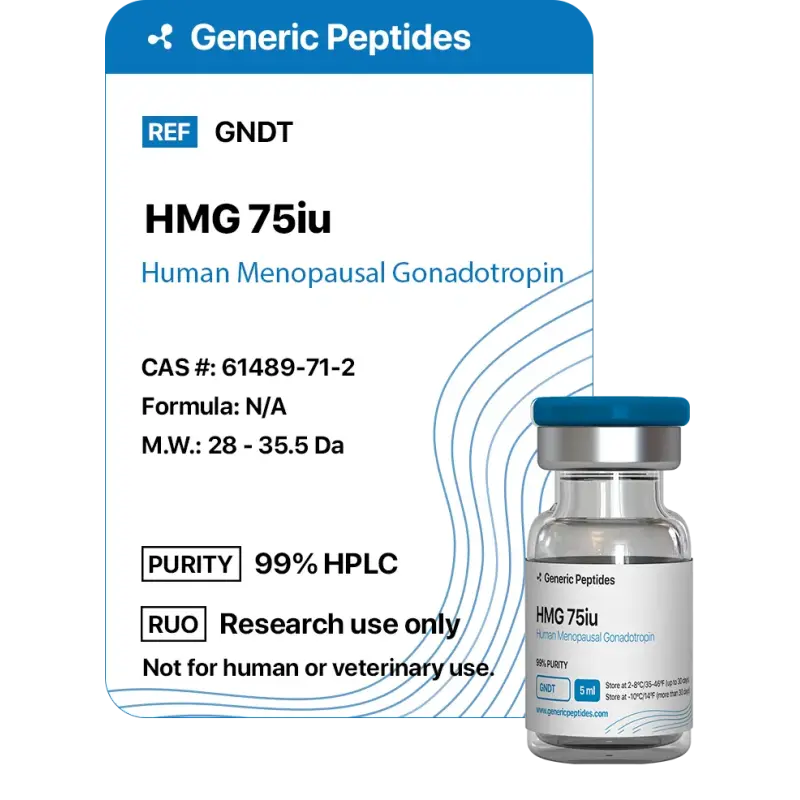
This is the 75 IU pack of menotropin sold under the Generic Peptides line: a single freeze-dried vial of the gonadotropin that clinics know as human menopausal gonadotropin. The name describes the source, not the user, since the raw material is recovered from the urine of postmenopausal women. Dosage is expressed in international units because a glycoprotein of this kind is standardised by biological activity, and the vial is filled to that standard rather than to a milligram figure.
Two activities travel together in the reference format, classically recorded as 75 IU of follicle stimulating hormone plus 75 IU of luteinising hormone per vial. The follicle stimulating component addresses the Sertoli cells that nurse sperm to maturity, with the luteinising component going after the interstitial Leydig population. That double reach explains the usual placement of the product: it stands beside a luteinising agent rather than replacing one, because the two cell populations have to be worked at the same time if fertility is the goal. Readers building that picture typically add HCG for the Leydig side, and a compound that sits even higher on the same axis, Kisspeptin-10, is studied for GnRH release.
Menotropin is an older technology. Recombinant gonadotropins have taken most of the clinic market, yet the urinary format remains the reference against which the newer versions are described. The one historical worry attached to it, transmission of infectious material from the donors, is treated in the sources as theoretical. Nothing here is a fertility treatment: this vial is a research material supplied in powder form, and the material below restates published data rather than prescribing anything.
Dosage Protocol
The rows below gather the amounts recorded in clinical references for menotropin together with vendor practice notes held in the project fact base. They restate the active substance rather than setting out a plan for this vial.
| Level | Amount | Length | Notes |
| Beginner | 75 IU a day | 5-10 days | The smallest working step in the reference material; dissolves in a small volume so a fine barrel helps |
| Intermediate | 75-150 IU a day | 10-14 days | Normally run beside a luteinising agent so both Leydig and Sertoli sides are covered |
| Advanced | 150 IU a day and up | Supervised only | Closer to clinical fertility protocols and laboratory-guided throughout |
| Female | No bodybuilding schedule | - | Clinical use is ovulation induction under medical control, which is a different setting entirely |
| Route | Under the skin or into muscle | - | Daily subcutaneous or intramuscular placement after the powder is dissolved |
| Duration | About 10 daily injections | - | Clinical schedules are adjusted to the response rather than fixed in advance |
Reconstitution is where a small vial becomes tricky, because 75 IU of powder disappears into almost any volume of water and the volume chosen sets the dose. A single millilitre of bacteriostatic water leaves the strength at 75 IU per millilitre, so a 0.1 ml draw from a U-100 barrel carries 7.5 IU. Diluting with 1.5 ml instead halves the strength to 50 IU per millilitre, so a 25 IU step becomes easier to measure while every injection carries extra volume. A 150 IU vial follows the same logic against its own nominal strength, and the water is run down the wall of the vial rather than squirted at the cake.
Suggested Protocols
Everything on this shelf is written for a research or recovery context, and none of the layouts below has been tested as a combination in a controlled trial. They are how the products in this section are read together.
Where tissue repair rather than hormone signalling is the topic, the repair peptides in this catalogue sit on their own shelf: TB 500 and BPC-157 are studied for local healing, not for the gonadal axis. Sexual-health items such as PT-141 work centrally on melanocortin receptors and are unrelated to gonadotropin signalling.
What to Expect
- Sperm output moves on a slow clock. The follicle stimulating arm works on Sertoli cells, and any change in a semen analysis appears over weeks, not days.
- Testosterone follows the luteinising contribution. On its own that push is weaker than a dedicated luteinising agent, which is the practical reason the pair is preferred.
- Volume support after long suppression. Testicular size is the measure people watch when a course has been running for months.
- Daily injections are the format. The reference schedules run around ten consecutive days, which is a shorter window than most recovery protocols.
- Water and pressure can shift. Fluid retention and a rise in blood pressure are described at the higher amounts, mostly through the oestrogen that follows increased testosterone.
- Headache is the common nuisance. It is reported individually and generally answers to a smaller amount.
- The urinary origin is a footnote, not a hazard. The infection worry attached to donor urine is described in the sources as theoretical, and the modern clinic has largely moved to recombinant products.
Side Effects and Management
Because the vial is a gonadotropin rather than a steroid, most tolerability notes belong to the hormonal shift it causes rather than to the powder itself.
Restoration Shelf and Laboratory Control
Menotropin is not a substitute for a SERM. A restart drug works by prompting the pituitary to signal again, while this vial supplies the gonadotropins themselves, so the two approaches sit at different levels of the same axis and are read as partners rather than alternatives.
Where a course of suppressive compounds caused the problem, the recovery protocol for those compounds still has to run on its own terms. This vial joins that work for a defined window and then stops. Anyone tracking the result should fix the testing dates in advance, because hormone values move quickly while a semen analysis needs roughly three months of sperm maturation before it reflects anything.