Product Overview
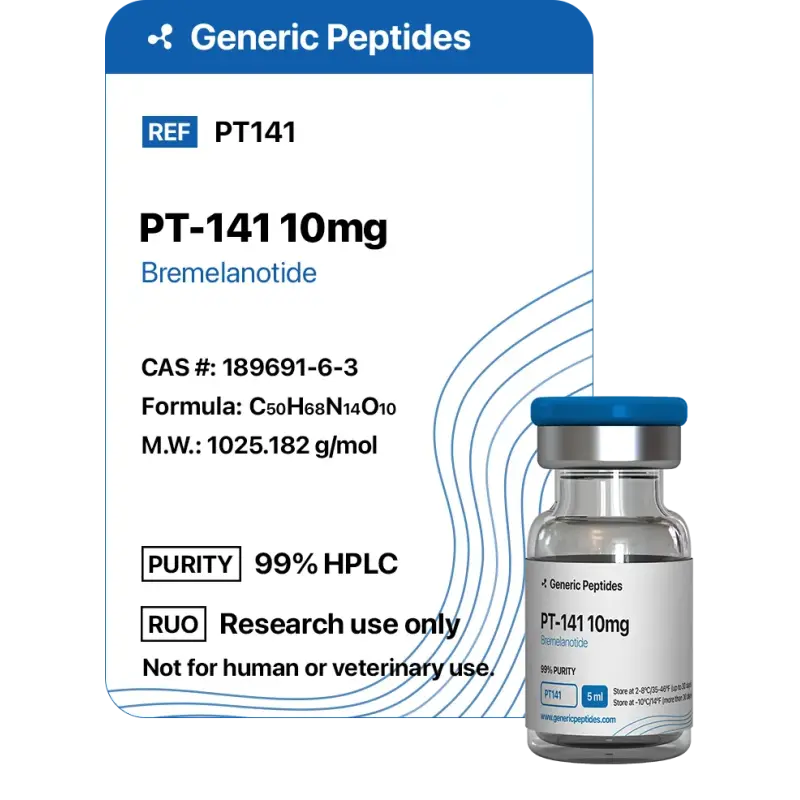
Generic Peptides lists this item as PT-141, a freeze-dried peptide vial for reconstitution and injection. The substance behind the code name is bremelanotide, and its route of action is the part most people get wrong. It does not widen vessels like a PDE5 tablet; it binds melanocortin receptors in the brain, with the strongest pull at MC4, and the outcome studied in trials is subjective desire rather than blood flow.
In chemical terms it is the parent peptide Melanotan II with one amide group taken off the end, which makes it the active metabolite of that molecule and explains why the two look alike and why the pigmentation side of the profile carries across. It has no activity at the androgen receptor, adds no muscle, and is not a replacement for anything the body stops making. Readers who assume every vial in a peptide catalogue builds tissue will find this one operates in a completely different system.
One bremelanotide product holds a licence, and it is not this vial. The registered injection is approved for hypoactive sexual desire disorder in premenopausal women, given subcutaneously at 1.75 mg when needed rather than on a daily schedule. That number is a medical reference point for the molecule, not a schedule for a research powder. Where low desire traces back to low testosterone instead, the relevant shelf is hormonal: HCG and HMG act on the gonadal axis, and Kisspeptin-10 sits above it. None of those has anything to do with melanocortin signalling.
Approved Label Versus Research Powder
Bremelanotide is unusual in this catalogue because a regulator has actually looked at the molecule in its registered form. The table separates what the label supports from what it does not, since the vial sold here is a different article.
| Item | Figure | Comment |
| Approved form | 1.75 mg subcutaneous | Registered injection for premenopausal women, taken when needed and not as a routine |
| Research vial | No approved amount | The powder has no label, so the figure above is orientation and not a target |
| Escalation | Not described as better | Raising the amount does not appear in the sources as giving a stronger effect |
| Half-life | About 2.7 hours | Range 1.9-4.0 hours, measured for the registered subcutaneous form |
| Onset | Within 1-2 hours | Effect holds for several hours, which matches the half-life rather than fighting it |
| Reference mix | 2 ml into 10 mg | 5 mg per ml; on a U-100 syringe the 1.75 mg reference would sit at 0.35 ml, the line marked 35 units |
| Repeat inside a day | Not described | Frequent use is tied to skin pigmentation rather than to a stronger result |
The last column of that mixing row is arithmetic, not a recommendation: it takes a dose belonging to a licensed product and converts it into a volume for a powder that was never assessed at that strength. A buyer should read the whole row as a warning about borrowed numbers rather than as a recipe.
Melanocortin Positioning and Pairings
The interesting question with this peptide is not what to stack it with but what it is not. The comparisons below are categorised by mechanism, because the compound is frequently described beside products that work in unrelated ways.
Within the stress and mood side of the catalogue, Selank and Semax are studied for their own central effects, which is a further reminder that a shared delivery route is not a shared mechanism.
What to Expect
- Effect arrives inside one to two hours. A subcutaneous injection produces its window within that time and holds for several hours, consistent with a half-life near 2.7 hours.
- Nausea is the headline complaint. Trial data for the registered product reported it in roughly 40 percent of users against 8 percent on placebo, usually mild or moderate and short-lived.
- Flushing and headache are common. Both are described as frequent but transient, and they set the practical limit on how the timing of a dose is planned.
- Frequency changes the skin. Darkening of the skin is reported with more regular use, so the tolerability profile is not fixed and depends on how often the peptide is taken.
- Blood pressure can shift. Changes in arterial pressure are noted in the warnings attached to the registered form, which is why uncontrolled hypertension is a reason to stay away.
- No anabolic effect exists to expect. The peptide is not a hormone and does not build muscle, so progress in the gym is not part of this card.
- The vial has no label. Every published number belongs to a licensed product with controlled manufacturing, and the powder is supplied for research only.
Side Effects and Management
The tolerability picture for bremelanotide is better documented than for most peptides here, because a registered version was studied in trials. The management notes below come from that material.
Timing, Storage and Follow-Up
There is no recovery protocol attached to this peptide. It does not suppress the gonadal axis and does not interfere with testosterone production, so a restart drug has nothing to act on, and the follow-up that matters is pressure and skin rather than hormones.
Doping status is worth stating precisely, because it is often assumed rather than checked: bremelanotide is not named on the WADA prohibited list in the sources consulted for this card, and no published detection window exists for the peptide. That is not the same as clearance, and anyone in a tested sport should verify the current list rather than rely on a product page.