Best Anabolic Steroids

Press Enter to search the full catalog.

US Domestic discreet shipping
Third-party batch tested
HPLC & MS verified purity
Trusted Anabolic Manufacturers Only
US Domestic discreet shipping
Third-party batch tested
HPLC & MS verified purity
Trusted Anabolic Manufacturers Only
Back to all products
CJC-1295 No DAC 2-10 mg Vials - Generic Peptides CJC-1295 No DAC 2-10 mg Vials - Generic Peptides CJC-1295 No DAC 2-10 mg Vials - Generic Peptides

Generic Peptides

CJC-1295 No DAC 2-10 mg Vials - Generic Peptides

Injection · 2 mg · vial

In stock · ships within 24h Out of stock Ships from International · U.S Domestic
CompoundMod GRF (1-29)
ClassGHRH analogue peptide
Half-lifeAbout 30 minutes
DetectionWADA S2, prohibited
Liver toxicityLow, not confirmed
Water retentionNot confirmed
The short half of the CJC-1295 pair, sold as 2 mg, 5 mg and 10 mg freeze-dried vials under the Mod GRF 1-29 label. No albumin anchor means roughly thirty minutes in circulation and a single growth hormone pulse, so the research convention is a daily injection rather than a weekly one. Vendor descriptions put the working range at 100 to 200 micrograms one to three times a day, which is a convention and not a validated schedule. Fluid retention and glucose effects are not confirmed for this variant, though they are known class effects of growth hormone secretagogues generally.
Strength

Not available in this combination

Shipping

Not available in this combination

CJC-1295 No DAC 2-10 mg Vials - Generic Peptides
Order Now, Ships Today
$35.00
3
Quality First

All products are manufactured under strict quality standards and independently tested before release. By purchasing, the buyer agrees to use these products in compliance with all applicable laws.

Product Overview

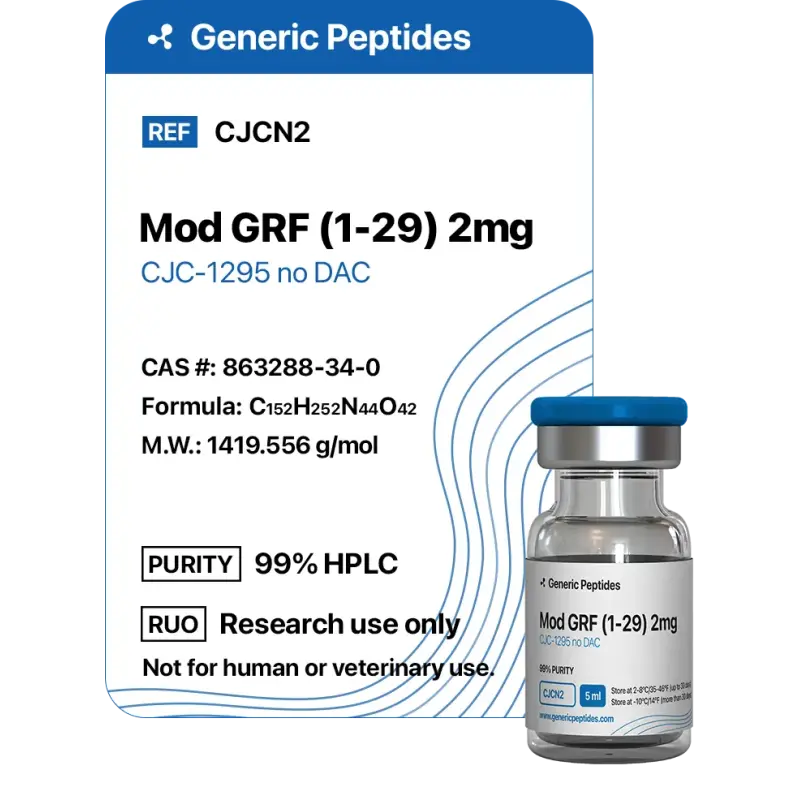
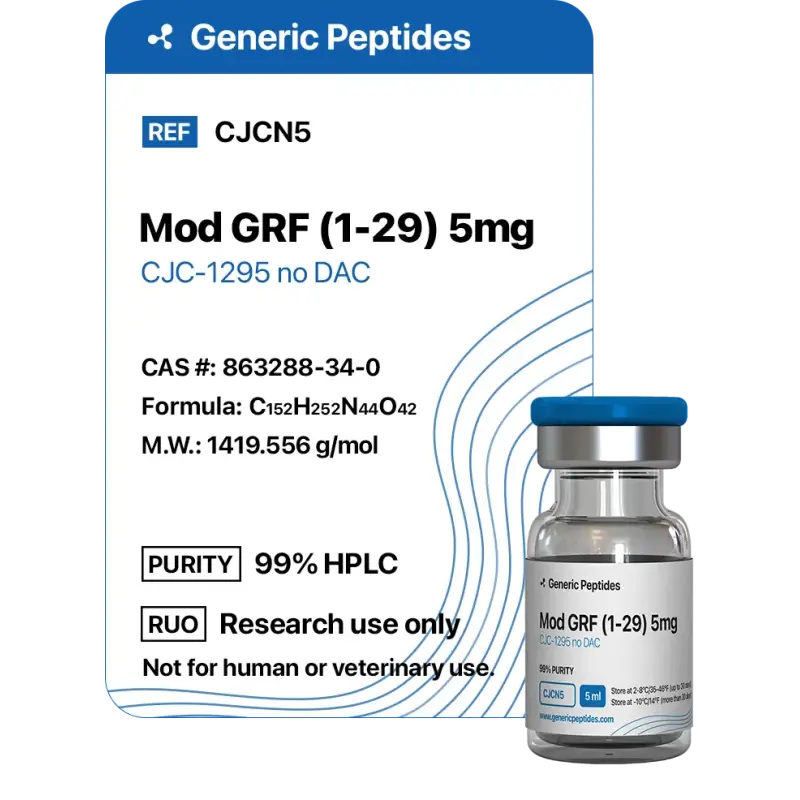
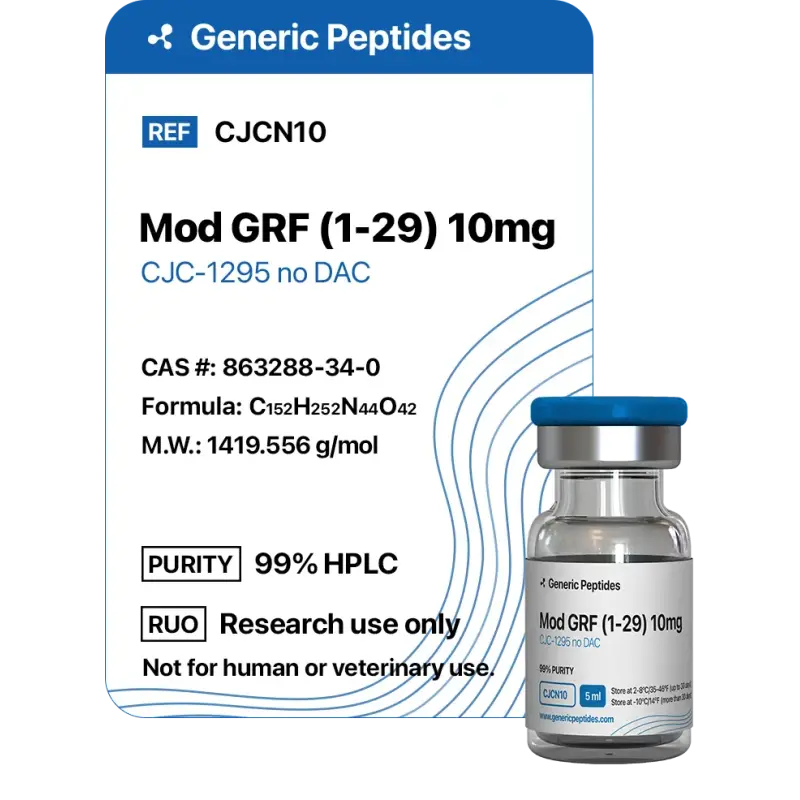
Strip the albumin anchor off CJC-1295 and what remains is modified growth hormone releasing factor 1-29, the peptide the catalogues label Mod GRF 1-29 or CJC-1295 no DAC. Generic Peptides stocks it as three freeze-dried vials: 2 mg, 5 mg and 10 mg. The sequence is a GHRH analogue with four substitutions that protect it from fast enzymatic breakdown, and the absence of the drug affinity complex is the single fact that defines its behaviour.

That difference is worth spelling out, because the two products share a name and almost nothing else. With the anchor the peptide rides on albumin and keeps growth hormone and IGF-1 high for days. Without it, clearance runs about thirty minutes and the pituitary releases hormone in one short burst. There is no multi-day IGF-1 elevation, no weekly rhythm and no plateau to speak of.

No human trial data exists for this variant, so the expectations below are drawn from the pharmacology of GHRH analogues rather than from measurements taken in people. It has no approved medicinal form in the United States or the European Union, and growth hormone releasing factors sit in WADA class S2, prohibited at all times. Where the sustained version suits a background level, this one suits a nightly pulse, and users comparing the two should read the long-acting CJC-1295 DAC entry alongside this one.

Dosage Protocol

Nothing below is an approved schedule. The concentration table is arithmetic for the vials on this page, and the amounts reflect vendor conventions in research descriptions.

Item Figure Comment
Half-life About 30 minutes Subcutaneous; produces one pulse instead of a plateau
Vendor convention 100-200 mcg per shot One to three times a day; no single protocol is standard
Timing convention Before sleep Daily use, sometimes with a second injection
2 mg vial plus 1 ml 2 mg/ml Ten units on a U-100 barrel carries 200 micrograms
5 mg vial plus 2 ml 2.5 mg/ml Ten units carries 250 micrograms
10 mg vial plus 2 ml 5 mg/ml Ten units carries 500 micrograms
Female - No verified female schedule appears in the sources

A thirty minute clearance means the injection rhythm, not the individual amount, is what shapes the result. Someone who injects once and expects a day-long effect is using the wrong product rather than the wrong dose; the long-acting presentation exists for exactly that reason.

Suggested Protocols

The logic of pairing here is receptor-based. A GHRH analogue and a ghrelin-receptor secretagogue push the same output through two different doors, and that is the arrangement most research descriptions use. No controlled trial has tested the combinations.

Two-receptor nightly arm
Mod GRF 1-29 - pre-sleep pulse + Ipamorelin - ghrelin side
The most quoted pairing in the peptide literature; two receptors, one nightly window, no joint human data
Pulse depth variants
Alternative ghrelin-side partners for the same GHRH pulse; side profiles differ, data does not exist for either pairing
Long versus short comparison
Mod GRF 1-29 - pulse profile + CJC-1295 DAC - sustained profile
Read as an either-or rather than a stack: frequency and IGF-1 behaviour are what separate them

Shelf neighbours with a different mechanism include Sermorelin, a shorter GHRH fragment with the longest clinical history of the group, and GHRP-6 where the appetite signal is the variable under study. Downstream of both sits IGF-1 LR3, which acts at the receptor level rather than on release.

What to Expect

  • No human data on this variant. Every expectation is an extrapolation from GHRH analogue pharmacology, which is worth saying before anything else.
  • A pulse, not a plateau. Roughly thirty minutes in circulation means growth hormone comes out in one short burst and then falls away.
  • No multi-day IGF-1 rise. That behaviour belongs to the anchored version; here the marker does not stay elevated between shots.
  • Daily injections. The rhythm is nightly, sometimes with a second dose, which is a commitment the weekly product does not ask for.
  • Stronger release when paired. A ghrelin-receptor secretagogue gives a more pronounced growth hormone response, which is why the pairing is common in descriptions.
  • Unconfirmed class effects. Fluid retention and glucose shifts are known for the class but are not confirmed for this variant.
  • No approved form anywhere. There is no licensed product in the United States or the European Union.

Side Effects and Management

Most of what is reported here is ordinary for subcutaneous peptides. Where the sources refuse to commit to a figure for this variant, the entry says so rather than borrowing a number.

Redness, soreness at the siteRotate injection points and keep technique clean. The frequent local complaint for the whole class.
Flushing or headache soon afterDilute properly and inject slowly, and reduce the amount. Described for GHRH analogues and dose-linked.
Glucose effects via the GH axisCheck blood sugar in a research setting. Not confirmed for the variant without DAC.
Fluid retentionObserve and reduce the amount if it appears. A general secretagogue effect, unconfirmed for this presentation.
Unknown long-term profileImmunogenicity and extended-use effects are not characterised, so duration is a judgement call.

Post-Cycle Therapy and Research Monitoring

There is no post-cycle protocol for this peptide line. Nothing in the sources describes suppression of the body's own hormonal axis of the kind androgens cause, so the recovery question simply does not arise.

Approval statusNo approved dosage form in the United States or the European Union
SportClass S2 covering growth hormone, its releasing factors and secretagogues; prohibited at all times
PCTNot applicable to the peptide line; no axis suppression is described in the sources
MonitoringGrowth hormone and IGF-1 levels plus glucose when characterising the pulse
Key differenceNo albumin anchor, therefore no multi-day action to wait out after the last injection

Storage is the same as for every other peptide in the line: powder cold, dark and dry; the mixed solution at 2-8 C for 28-30 days at most; no freezing. Because a 10 mg vial at 5 mg per ml stretches a long way at 100-200 microgram amounts, the realistic risk is a solution that outlives its own shelf life rather than a shortage.
This material is published for educational and research reference purposes only. The compounds described are research-grade materials supplied for laboratory work and are not presented here as medicines or as a treatment for any condition. Dosing information reflects published clinical and reference data for the active substances, not a recommendation or a prescription. Nothing on this page should be read as medical advice. Keep all products out of reach of children and follow the regulations that apply in your country.
What is CJC-1295 without DAC?
It is modified growth hormone releasing factor 1-29, a GHRH analogue with four substitutions that slow its breakdown but no albumin-binding anchor. Catalogues call it Mod GRF 1-29. It asks the pituitary for a burst of growth hormone rather than holding a level.
How does it compare with the DAC version?
One number explains it. The anchored peptide lasts 5.8 to 8.1 days and is injected once or twice a week; the unanchored version lasts around thirty minutes and is injected daily. The DAC variant keeps IGF-1 high for days, this one does not.
How often is it injected in research descriptions?
Daily, usually before sleep, and sometimes a second time in the day. Vendor conventions put each shot at 100 to 200 micrograms, one to three times a day, though no single protocol is agreed and no female schedule is verified.
Which peptide is normally paired with it?
Ipamorelin is the usual partner, since it acts on the ghrelin receptor while the GHRH analogue acts on its own receptor, and the two routes feed the same release. GHRP-2, GHRP-6 and hexarelin appear as alternative ghrelin-side partners.
How do you mix the 2 mg, 5 mg and 10 mg vials?
One millilitre into the 2 mg vial gives 2 mg per ml, where ten units equals 200 micrograms. Two millilitres into the 5 mg vial gives 2.5 mg per ml and 250 micrograms per ten units, and two millilitres into the 10 mg vial gives 5 mg per ml and 500 micrograms. Swirl, never shake.
Is PCT needed after using it?
No. The sources describe no suppression of the body's own hormonal axis from this peptide line, so there is nothing for a SERM such as tamoxifen or clomiphene to restart. Monitoring growth hormone, IGF-1 and glucose is the relevant follow-up.
What side effects are reported with GHRH peptides?
Redness or soreness where the needle went in, and a flushing sensation or headache shortly after a dose. Glucose effects through the growth hormone axis and fluid retention are class concerns, but neither is confirmed specifically for the unanchored variant.
Is it legal and is it banned in sport?
It has no approved medicinal form in the United States or the European Union, so it is sold as a research material. In sport, growth hormone releasing factors and secretagogues are prohibited at all times under WADA class S2, in and out of competition.

No reviews yet

Be the first to share your experience with CJC-1295 No DAC 2-10 mg Vials - Generic Peptides

Log in to write a review
CJC-1295 No DAC 2-10 mg Vials - Generic Peptides
2 mg · International

Complete the protocol

Stack it with

View all →
Added to cart