Product Overview
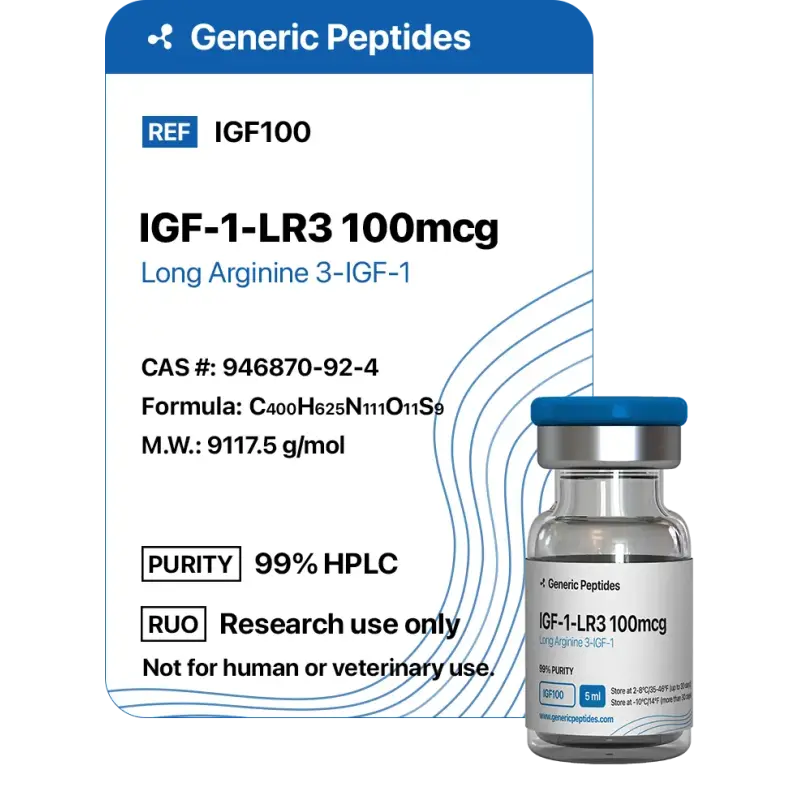
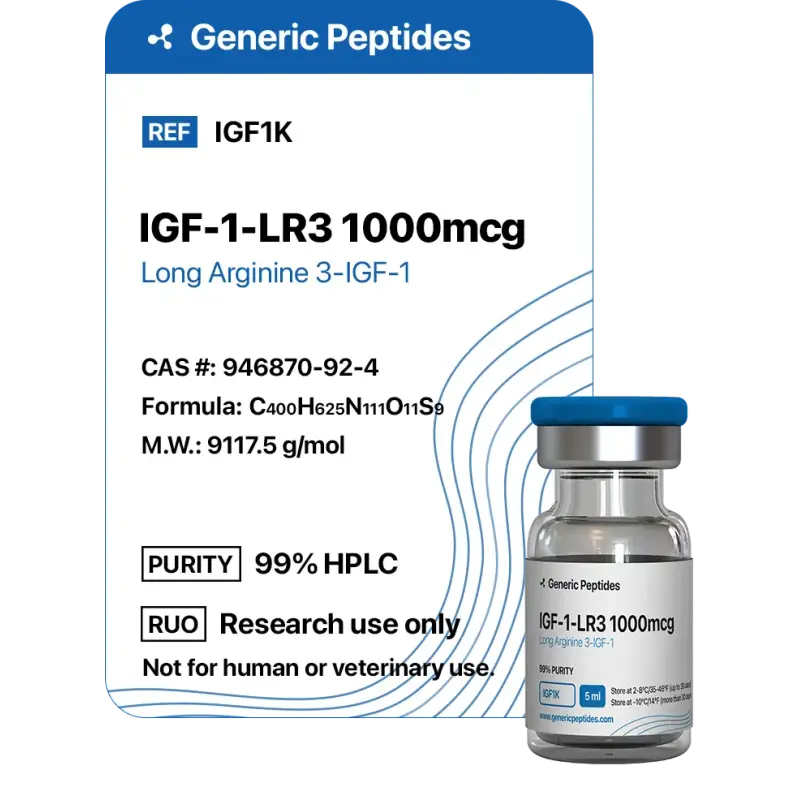
IGF-1 LR3 is a synthetic version of insulin-like growth factor 1, rebuilt so that the body cannot disarm it quickly. The natural hormone spends most of its time bound to carrier proteins called IGFBPs, which keep it inactive and steady. In LR3 an arginine replaces glutamic acid at position three, and thirteen extra amino acids were added, giving 83 residues instead of 70. The result binds those carriers poorly, which leaves more free hormone in circulation and makes it both stronger and longer-lasting.
Generic Peptides lists it as a 100 mcg and a 1 mg lyophilised vial. It sits downstream of growth hormone in the same signalling chain, which is why it appears beside Somatropin rather than instead of it. Nothing here has been through a human trial: the only approved recombinant IGF-1, mecasermin, is a different molecule used in severe primary IGF-1 deficiency.
The size of the effect is why the warnings matter. With less carrier binding, the hormone can drive blood sugar down, and hypoglycaemia is the class risk carried in the approved product's labelling. A 100 mcg vial holds a tiny absolute amount of powder, so dilution has to be calculated carefully before anything else is decided.
Dosage Protocol
No clinical protocol exists for this analogue. Community figures are the only ones available, they are not reviewed data, and the sources checked list no female version of them.
| Item | Figure | Basis |
| Starting figure | 20-30 mcg daily | Community protocol, not clinical |
| Working range | 30-50 mcg daily | Community protocol |
| Frequency | One shot, usually after training | Community convention |
| Course length | 4-6 weeks, then a break | Community convention |
| Female | No separate figures | Nothing found in the sources checked |
The arithmetic is the difficult part, because the vials differ by a factor of ten. One millilitre into the 1 mg vial gives 1 mg per millilitre, which is 1000 mcg per millilitre and 100 mcg in every tenth of a millilitre; a 30 mcg amount is therefore three units on a U-100 syringe. Two millilitres halves that to 50 mcg per tenth. The 100 mcg vial is easier to handle in the sense that it holds one or two small amounts in total, but it is not a convenient size for a multi-week course.
Suggested Protocols
Community protocols treat this as either a standalone peptide or part of a growth hormone arrangement. Neither has clinical backing, and the pairings below describe how the compounds relate rather than a tested recipe.
Recovery peptides are frequently mentioned beside it: BPC-157 for connective tissue and gut work and TB 500 for soft tissue models. Also on the growth shelf are Sermorelin and Tesamorelin, both GHRH-side peptides that sit above this compound in the signalling order. Monitoring glucose is the one habit every source agrees on.
What to Expect
- Low blood sugar can arrive in the first hour. Hunger, shaking and weakness within 30 to 60 minutes of a shot are the class effect of IGF-1 signalling.
- Early weeks feel like fullness. User reports of muscle fullness and faster recovery in days one to seven are exactly that, reports, with no clinical data behind them.
- Strength changes over the first weeks. Weeks one to two are described as the point where tolerance work improves, alongside a rising appetite.
- The main window is short. The typical community course lasts four to six weeks, and the recorded effects belong to that window.
- No human trial of LR3 exists. Mecasermin is approved for a narrow deficiency indication, and it is not this analogue.
- Stopping ends the effect. Long use may blunt the body's own growth hormone and IGF-1 signalling, following the same logic as other hormones.
- Doping rules catch it. IGF-1 and growth factors sit in class S2, with no established detection window published for the analogue.
Side Effects and Management
The list is led by blood sugar, and everything else follows the ordinary pattern of injected peptides.
Post-Cycle Therapy (Axis Caution)
A steroid recovery protocol does not apply, because the gonadal axis is untouched and no SERM has anything to restart. The relevant recovery question is different: how quickly the body's own growth hormone and IGF-1 signalling returns to normal after a course.
Store the powder cold and dark, and keep the reconstituted solution refrigerated between 2 and 8 C without repeated freezing and thawing, which damages peptides quickly.