Best Anabolic Steroids

Press Enter to search the full catalog.

US Domestic discreet shipping
Third-party batch tested
HPLC & MS verified purity
Trusted Anabolic Manufacturers Only
US Domestic discreet shipping
Third-party batch tested
HPLC & MS verified purity
Trusted Anabolic Manufacturers Only
Back to all products
PEG MGF 2-5 mg Vials - Generic Peptides PEG MGF 2-5 mg Vials - Generic Peptides

Generic Peptides

PEG MGF 2-5 mg Vials - Generic Peptides

Injection · 2 mg · vial

In stock · ships within 24h Out of stock Ships from International · U.S Domestic
CompoundPEG MGF
ClassIGF-1 splice variant
Half-lifeConflicting figures
DetectionWADA S2, prohibited
Liver toxicityLow, not confirmed
Water retentionNone described
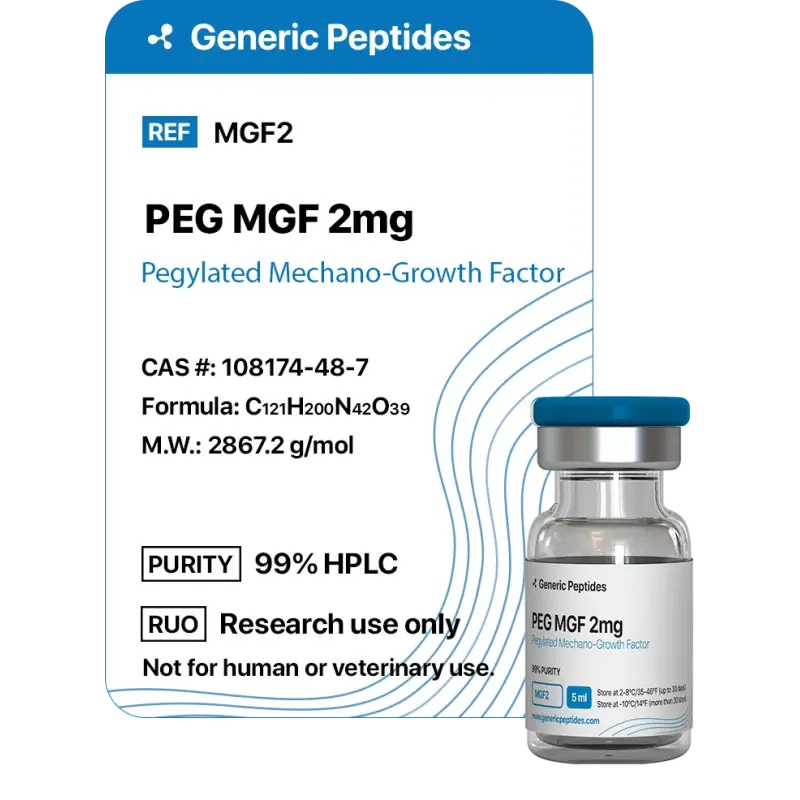
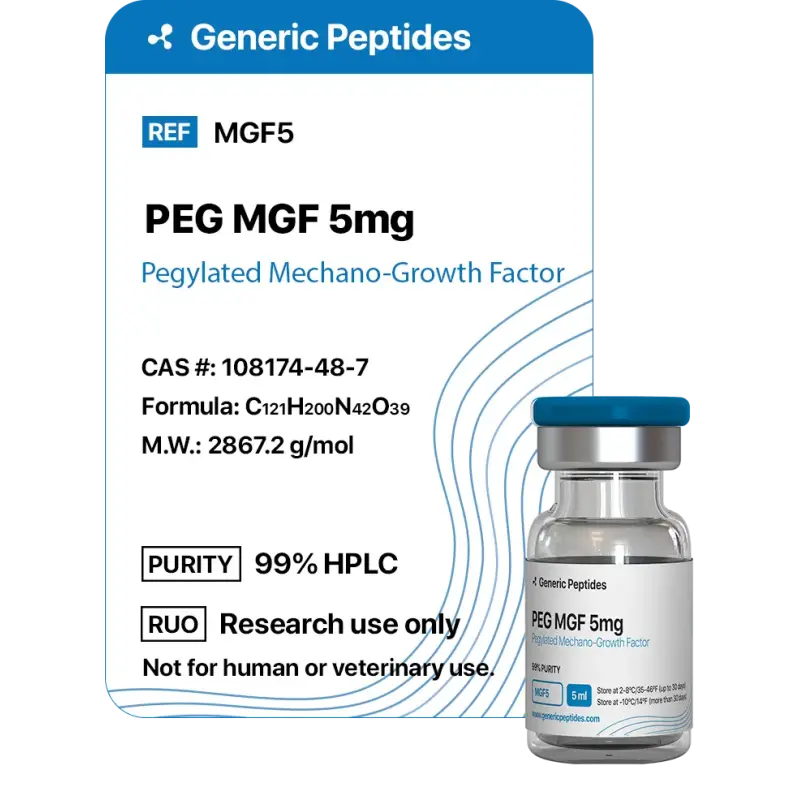
Two freeze-dried vials, 2 mg and 5 mg, of a splice variant of IGF-1 called IGF-IEc that appears in muscle after hard loading and signals the cells that rebuild it. Adding polyethylene glycol to the molecule slows its breakdown, but the published half-life figures range from 2 to 3 minutes for the unmodified version up to 30 to 60 minutes, 48 to 72 hours and even five days for the pegylated form. No human pharmacokinetic study exists to settle which is right.
Strength

Not available in this combination

Shipping

Not available in this combination

PEG MGF 2-5 mg Vials - Generic Peptides
Order Now, Ships Today
$43.00
3
Quality First

All products are manufactured under strict quality standards and independently tested before release. By purchasing, the buyer agrees to use these products in compliance with all applicable laws.

Product Overview

Mechano growth factor is not a drug in the ordinary sense. It is a naturally occurring splice variant of IGF-1, written as IGF-IEc, produced inside muscle when tissue is loaded or damaged. Its job in that setting is to wake the satellite cells that repair and thicken muscle fibres, which makes it a local repair signal rather than a systemic hormone. Pegylating the molecule attaches a chain of polyethylene glycol that slows enzymatic breakdown and keeps it in circulation longer than the unmodified form.

Generic Peptides offers 2 mg and 5 mg lyophilised vials. Everything about them is research material, and the compound holds no approval anywhere. Its relationship to the rest of the shelf is easy to misread: IGF-1 LR3 is the circulating, systemic version of the same family, while this one is studied for what happens at the injection site.

The honest summary is that the molecule is better described in tissue models than in people. Human pharmacokinetics do not exist, and the half-life numbers circulating in vendor guides conflict wildly with one another, which is a warning about the quality of the underlying material rather than a detail to be averaged.

Dosage Protocol

The figures below are vendor convention for a product with no clinical protocol. No female schedule appears in the sources, and the discordant half-life figures mean timing advice is approximate at best.

Item Figure Basis
Research amounts 200-400 mcg, two to three times a week Vendor convention
Alternative pattern One to two times a week Other vendor sources disagree
Injection style Into the target muscle in research models Local signalling is the premise
Half-life Sources conflict, from minutes to days No human study exists
Female No data Sources list none

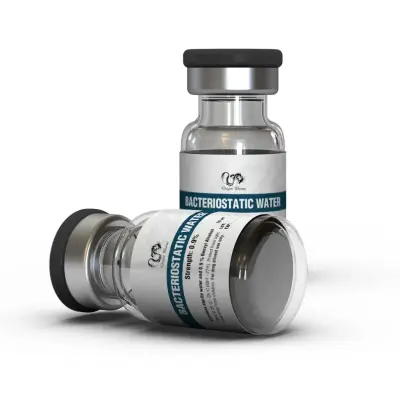
Dilution is done with bacteriostatic water, 1 to 2 ml per vial, added down the side without shaking. One millilitre in the 2 mg vial gives 2 mg per millilitre, which is 200 mcg in a tenth of a millilitre and 10 units on a U-100 syringe. Two millilitres brings the same tenth down to 100 mcg. The 5 mg vial at 1 ml gives 500 mcg per tenth and at 2 ml gives 250 mcg, so the same powder can be set up in four different strengths depending on volume.

Suggested Protocols

Research work with this molecule is about local regeneration models, so the combinations below show how it relates to other compounds rather than a protocol to follow.

Local against systemic
PEG MGF - site of injection vs IGF-1 LR3 - whole body
The same growth factor family read two ways; comparing them is the point, not stacking them
Recovery line
Repair peptides that appear beside MGF in research write-ups; none of the three has human trial data

Growth hormone options sit at a different level of the same chain: Somatropin supplies the hormone directly, while Ipamorelin and CJC-1295 DAC ask the pituitary for it, and GHRP-6 covers the appetite-led route. Tesamorelin is the GHRH analogue with clinical data.

What to Expect

  • Expect local rather than whole-body effects. The research premise is action at the injection site, which is the opposite of the circulating IGF-1 story.
  • The signal is short-lived naturally. Unmodified MGF has been measured at 2 to 3 minutes, and pegylation is the only reason it lasts longer at all.
  • Half-life figures contradict each other. Vendor and clinical write-ups quote 30 to 60 minutes, 48 to 72 hours and about five days, and no human study settles the question.
  • Tissue models look promising. Enhanced myogenic differentiation and protein synthesis appear in laboratory work, which is not evidence about people.
  • MGF expression stays elevated after loading. In natural biology it can remain raised for up to eight weeks after a heavy stimulus.
  • A cancer question is open. Literature cited in the sources raises it; nobody has confirmed it independently, so it remains unresolved rather than disproved.
  • No approval exists. The product is research-grade material with no licensed use anywhere.

Side Effects and Management

What is described is largely local and theoretical, because the human data simply are not there.

Injection site reactionRotate sites and keep technique clean. The most commonly reported effect for injected peptides.
Local soreness and muscle swellingLower the research amount. Reported in user accounts rather than demonstrated in studies.
Cancer question from the literatureUnresolved and not independently confirmed. Anyone reading it should treat it as an open concern, not a settled risk.
Systemic effects at high amountsData are too thin to describe. Caution is the only defensible position.
Immune response to a pegylated peptidePossible in principle, poorly documented in practice. Nothing specific has been established.

Post-Cycle Therapy (Not a Steroid)

No hormone recovery programme applies. This is a growth factor studied in muscle tissue, not a suppressive steroid, so tamoxifen or clomiphene would address nothing, and the sources describe no such protocol for any peptide in this line.

OnsetNot applicable: the gonadal axis is not involved
Option ANot applicable
Option BNot applicable
RegulatoryNo approval anywhere; class S2 covers mechano growth factors in sport
Follow-upNothing specific is defined, which is itself the practical answer

Store the powder cold and protected from light, and it tolerates longer storage frozen. Once mixed, keep it between 2 and 8 C, use it within about four weeks, never freeze it, and throw away a solution that turns cloudy.
This material is published for educational and research reference purposes only. The compounds described are research-grade materials supplied for laboratory work and are not presented here as medicines or as a treatment for any condition. Dosing information reflects published clinical and reference data for the active substances, not a recommendation or a prescription. Nothing on this page should be read as medical advice. Keep all products out of reach of children and follow the regulations that apply in your country.
What is PEG MGF and where does it come from?
It is a pegylated form of mechano growth factor, a splice variant of IGF-1 written as IGF-IEc. Muscle makes it naturally after loading or damage to recruit the cells that rebuild fibres, so the research interest is local repair rather than a whole-body hormone effect.
Why is MGF pegylated?
The unmodified peptide is destroyed almost immediately, with figures as short as two or three minutes. Attaching polyethylene glycol slows that enzymatic breakdown and keeps the molecule around for longer, although how much longer is exactly what the sources disagree about.
How do you mix a 2 mg or 5 mg vial?
Add bacteriostatic water down the wall of the vial without shaking. One millilitre in the 2 mg vial puts 200 mcg in a tenth of a millilitre; two millilitres halves it to 100 mcg. The 5 mg vial gives 500 mcg per tenth at 1 ml and 250 mcg at 2 ml.
What amounts are used in MGF research?
Vendor guides describe roughly 200 to 400 mcg two or three times a week, while others prefer one or two sessions a week. There is no agreed protocol, no dose-finding study and nothing peer-reviewed behind either pattern.
Does PEG MGF build muscle in humans?
Nobody can answer that honestly. Laboratory models show stronger myogenic differentiation and protein synthesis, but there is no clinical study in people, so any claim about human muscle growth is extrapolation from cells and animals.
What is the half-life of PEG MGF?
The sources contradict one another: two to three minutes for the unmodified peptide, 30 to 60 minutes in a vendor guide, 48 to 72 hours in clinical write-ups and about five days in some references. No human measurement exists to settle it.
Is PEG MGF banned in sport?
Yes. Mechano growth factors are listed in class S2 and prohibited at all times, in and out of competition, because they act through the growth hormone and IGF-1 pathways.
Where to buy PEG MGF online?
This is the Generic Peptides listing for the 2 mg and the 5 mg vial, supplied as powder with no solvent in the box. Because the material is unapproved and banned in sport, buyers should check what their own jurisdiction allows.

No reviews yet

Be the first to share your experience with PEG MGF 2-5 mg Vials - Generic Peptides

Log in to write a review
PEG MGF 2-5 mg Vials - Generic Peptides
2 mg · International

Complete the protocol

Stack it with

View all →
Added to cart