Best Anabolic Steroids

Press Enter to search the full catalog.

US Domestic discreet shipping
Third-party batch tested
HPLC & MS verified purity
Trusted Anabolic Manufacturers Only
US Domestic discreet shipping
Third-party batch tested
HPLC & MS verified purity
Trusted Anabolic Manufacturers Only
Back to all products
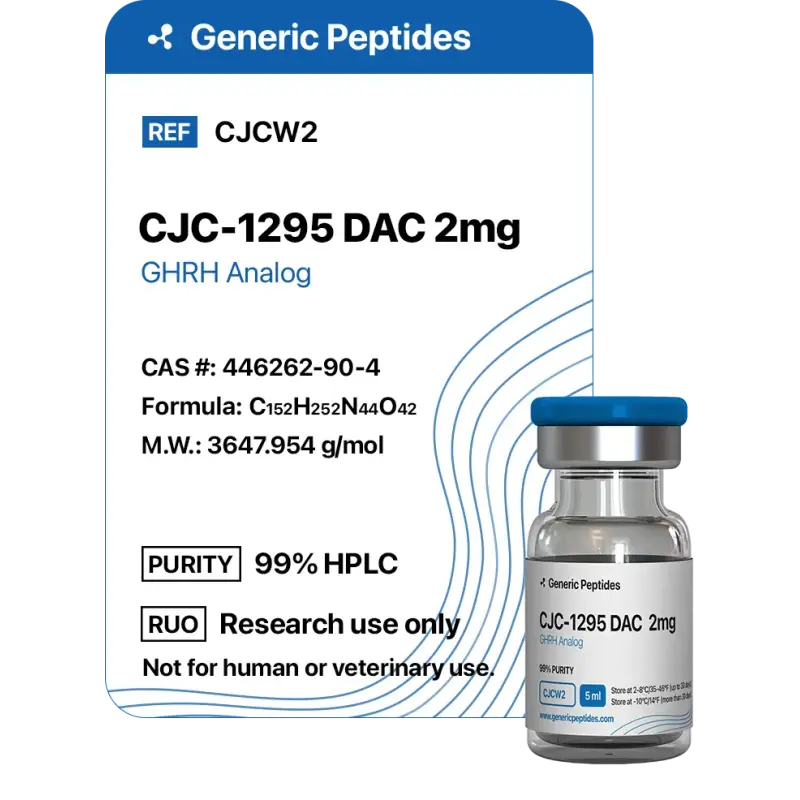
CJC-1295 DAC 2-10 mg Vials - Generic Peptides CJC-1295 DAC 2-10 mg Vials - Generic Peptides CJC-1295 DAC 2-10 mg Vials - Generic Peptides

Generic Peptides

CJC-1295 DAC 2-10 mg Vials - Generic Peptides

Injection · 2 mg · vial

In stock · ships within 24h Out of stock Ships from International · U.S Domestic
CompoundCJC-1295 with DAC
ClassGHRH analogue peptide
Half-life5.8-8.1 days
DetectionWADA S2, prohibited
Liver toxicityLow, not confirmed
Water retentionModerate, class-level
Three freeze-dried vials of the modified GHRH analogue carrying an albumin-binding anchor, which is what stretches its half-life to about 5.8-8.1 days after a subcutaneous shot. One injection held plasma growth hormone 2-10 times above baseline for six days and more in the clinical program, with IGF-1 rising 0.5-3 times over 9-11 days and staying up as long as 28 days when doses were repeated. Development stopped at phase II in 2006 after a participant death, so no approved schedule exists. Fluid retention is a class effect of growth hormone secretagogues rather than a figure measured for this peptide alone.
Strength

Not available in this combination

Shipping

Not available in this combination

CJC-1295 DAC 2-10 mg Vials - Generic Peptides
Order Now, Ships Today
$35.00
1
Quality First

All products are manufactured under strict quality standards and independently tested before release. By purchasing, the buyer agrees to use these products in compliance with all applicable laws.

Product Overview

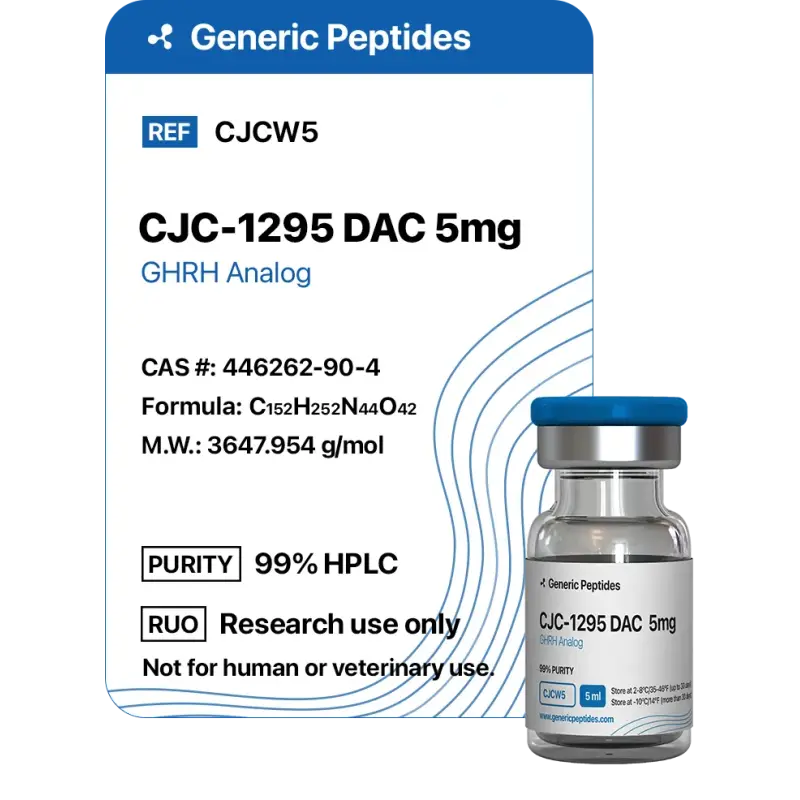
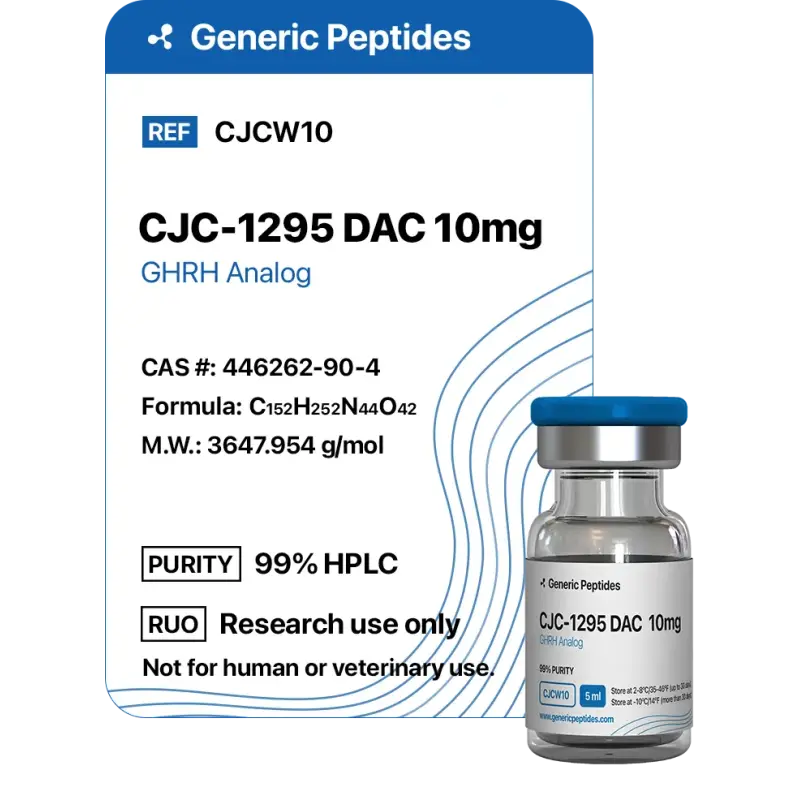
This is the long-acting half of the CJC-1295 family, sold by Generic Peptides in 2 mg, 5 mg and 10 mg freeze-dried vials. What separates it from the short version is a drug affinity complex, a small anchor that lets the peptide ride on circulating albumin. A 30 amino acid tetrasubstituted GHRH analogue with that anchor behaves very differently from the same sequence without it: instead of a pulse it produces a plateau.

The clinical program behind it was real and is the reason the pharmacokinetics are well described. A single subcutaneous injection raised plasma growth hormone 2-10 times above baseline for six days or longer, and IGF-1 climbed 0.5-3 times within 9-11 days, with repeated dosing keeping the level up for as long as 28 days. Half-life estimates in review work land between 5.8 and 8.1 days, so the range is quoted rather than an average.

The same program also ended, and that matters more than the numbers. Development for lipodystrophy and growth hormone deficiency reached phase II and stopped in 2006 after a participant death, so there is no approved dose and no approved form. Because a long-acting secretagogue is judged next to a pulsatile one, the useful comparison in the catalogue is CJC-1295 no DAC, and the finished hormone sits further along the same axis as Somatropin.

Dosage Protocol

Because release runs in days rather than hours, frequency is the main variable and single-dose size matters far less. The figures below come from the clinical program and from vendor arithmetic, not from an approved label.

Item Figure Comment
Half-life 5.8-8.1 days Subcutaneous route; the albumin anchor is responsible
Frequency in descriptions Once or twice weekly Rare injections follow directly from the half-life; no single protocol is agreed
Growth hormone response 2-10 times baseline Held for six days and longer after one dose in the clinical work
IGF-1 response 0.5-3 times higher Peak within 9-11 days, still raised at 28 days with repeat dosing
Female - No female schedule is confirmed in the sources

Reconstitution sets the concentration for whichever vial is on the bench. Mixing 2 ml into the 5 mg vial leaves 2.5 mg per millilitre, so a tenth of a millilitre holds 250 micrograms; the same 2 ml in the 10 mg vial doubles the strength to 5 mg per millilitre, or 500 micrograms per 0.1 ml; and the 2 mg vial with 1 ml sits at 2 mg per millilitre, which is 200 micrograms in that volume. Add the water down the side of the vial and swirl, because shaking damages peptides.

Suggested Protocols

Secretagogues are described in pairs for a simple reason: growth hormone releasing hormone and ghrelin act on different receptors, so combining them is a way of pulling two levers at once. None of the arrangements below has been run through a controlled human study.

Background plus pulse
CJC-1295 DAC - weekly background + Ipamorelin - pre-sleep pulse
The most common arrangement in research writing: a steady level from one peptide and a nightly spike from the other
Ghrelin-side variants
Same receptor family, different side profile: GHRP-2 is the sharper of the two and GHRP-6 brings hunger with it
GHRH comparison shelf
Three GHRH analogues on one shelf; only tesamorelin has an approved product and trial data behind it

Where a shorter pulse is wanted instead of a plateau, Hexarelin belongs to the ghrelin side of the same discussion. Anyone chasing the hormone itself rather than its release should look one step downstream, where Somatropin supplies the finished molecule directly.

What to Expect

  • Days, not hours. One shot keeps growth hormone elevated for six days and longer, which is the entire reason injections are weekly.
  • IGF-1 lags behind. The rise takes 9-11 days to peak, and repeat doses can hold it up for 28 days, so bloodwork tracks slowly.
  • Class-level complaints first. Fluid retention, joint aches, injection site reactions and changing glucose tolerance are the expected early signals.
  • Skin, sleep and recovery before strength. In research accounts those are the first things noticed, and visible change takes weeks.
  • Long tail after stopping. Because the anchor works through albumin, the effect does not end on the day of the last injection.
  • No approved reference point. There is no approved form and no approved dose, and the development program was halted in 2006.
  • Testing. Growth hormone releasing factors sit in WADA class S2 and are prohibited at all times, in and out of competition.

Side Effects and Management

Most entries are class effects of growth hormone secretagogues, and the sources do not offer a separate frequency table for this peptide. Anything below is therefore a class-level observation.

Fluid retention, puffinessCut the number of injections per week and watch how it feels. Class effect, not confirmed separately for this peptide.
Joint and muscle achesReduce frequency and reassess. More likely with a sustained growth hormone level than with a short pulse.
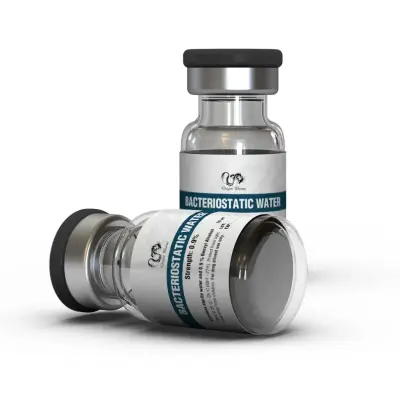
Injection site reactionsRotate sites, use clean technique and bacteriostatic water. The usual local complaint for the class.
Glucose tolerance changesCheck glucose on long runs, since chronically raised IGF-1 accompanies the risk. Class effect at sustained exposure.
Flushing or headache after a shotSlow the injection and observe. Reported by users; no systematic data exists.
Unresolved safety questionA phase II program stopped in 2006 after a participant death; that fact belongs in the risk column, not a footnote.

Post-Cycle Therapy and Follow-Up

This peptide does not suppress the gonadal axis, so a SERM-based recovery protocol is not part of the picture. Because it works through the body's own pituitary signalling, the sensible end of a block is a taper of frequency and a set of checks.

OnsetGrowth hormone rises within hours and stays up for days thanks to albumin binding
PCTNot applicable; the gonadal axis is untouched, so tamoxifen or clomiphene has no role
Protocol shapeA rare-injection background with IGF-1 checked as the clinical program did, or a pairing with a ghrelin-receptor secretagogue
Length beats sizeBecause IGF-1 accumulates, duration of use is the variable that matters more than any single amount
Follow-upIGF-1, glucose, joints and general wellbeing; there is no medical monitoring scheme validated for research use

Storage is ordinary peptide housekeeping: keep the powder cold and protected from light, use a mixed vial within a month of mixing and keep it refrigerated, and never put it in the freezer. With vials as large as 10 mg and injections as rare as weekly, an unused mixed solution is the most likely thing to be wasted.
This material is published for educational and research reference purposes only. The compounds described are research-grade materials supplied for laboratory work and are not presented here as medicines or as a treatment for any condition. Dosing information reflects published clinical and reference data for the active substances, not a recommendation or a prescription. Nothing on this page should be read as medical advice. Keep all products out of reach of children and follow the regulations that apply in your country.
What does the DAC in CJC-1295 DAC actually do?
DAC stands for drug affinity complex, an anchor that lets the peptide bind circulating albumin. That binding is what stretches the half-life from about half an hour to somewhere between 5.8 and 8.1 days, turning a pulse into a sustained level of growth hormone and IGF-1.
How often is an injection described with the DAC version?
Once or twice a week appears in the descriptions, and that spacing follows from the half-life rather than from a trial protocol. No single research arrangement is standard, and the sources contain no female schedule at all.
Is this the same product as CJC-1295 no DAC?
The GHRH sequence is related, but the anchor changes the behaviour completely. Without DAC the peptide is cleared in roughly thirty minutes and injected daily, giving a pulse. With DAC it keeps growth hormone and IGF-1 elevated for days and is injected once or twice a week.
What did the clinical program show?
One injection lifted plasma growth hormone 2-10 times above baseline for six days and more, and IGF-1 rose 0.5-3 times, peaking over 9-11 days and remaining high for up to 28 days when doses were repeated. Development for lipodystrophy and growth hormone deficiency stopped at phase II in 2006 after a participant death.
How do you prepare the 2 mg, 5 mg and 10 mg vials?
Mixing 2 ml into the 5 mg vial leaves 2.5 mg per millilitre and a tenth of a millilitre holds 250 micrograms. The same 2 ml in the 10 mg vial doubles the strength, so 0.1 ml carries 500 micrograms, and the 2 mg vial with 1 ml gives 200 micrograms in that same small volume. Water goes down the glass wall and the vial is swirled.
Can it be stacked with another peptide?
Research writing pairs GHRH analogues with ghrelin-receptor secretagogues such as ipamorelin, GHRP-2 or GHRP-6, because the two receptors feed the same output by different routes. No controlled trial has tested any of those pairings together.
Does it require PCT after a course?
No. Testosterone production is not suppressed, so a SERM protocol would have nothing to act on. The practical finish is to space injections out and to keep checking IGF-1 and glucose, since the albumin-bound effect lingers after the last shot.
What are the main side effects to watch?
Fluid retention, joint and muscle pain, reactions at the injection site and shifts in glucose tolerance, all as class effects of growth hormone secretagogues. Reports also mention flushing and headache after a dose. No frequency table specific to this peptide exists in the sources.

No reviews yet

Be the first to share your experience with CJC-1295 DAC 2-10 mg Vials - Generic Peptides

Log in to write a review
CJC-1295 DAC 2-10 mg Vials - Generic Peptides
2 mg · International

Complete the protocol

Stack it with

View all →
Added to cart