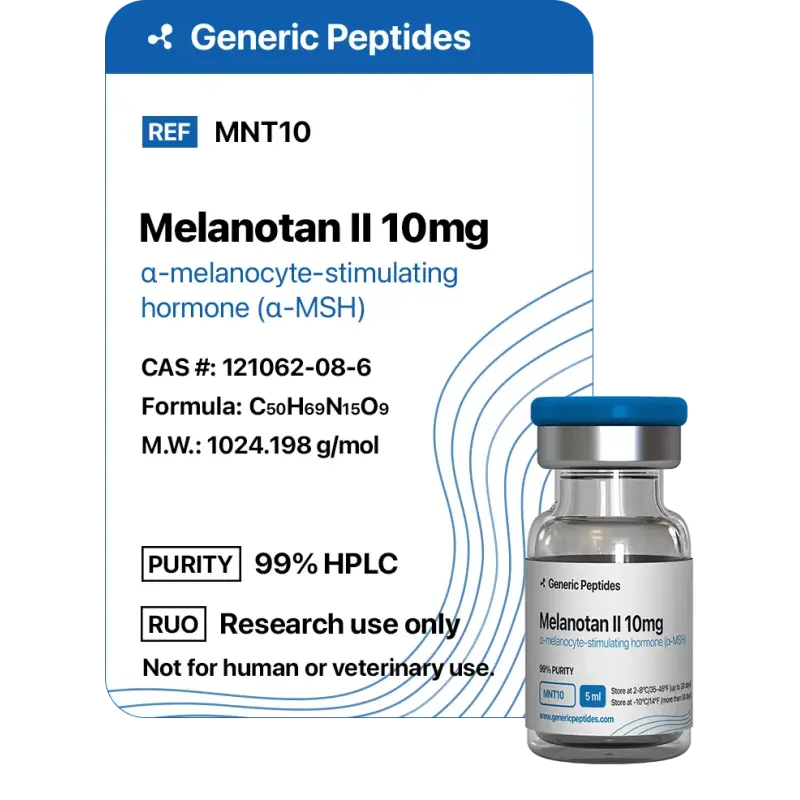
Product Overview
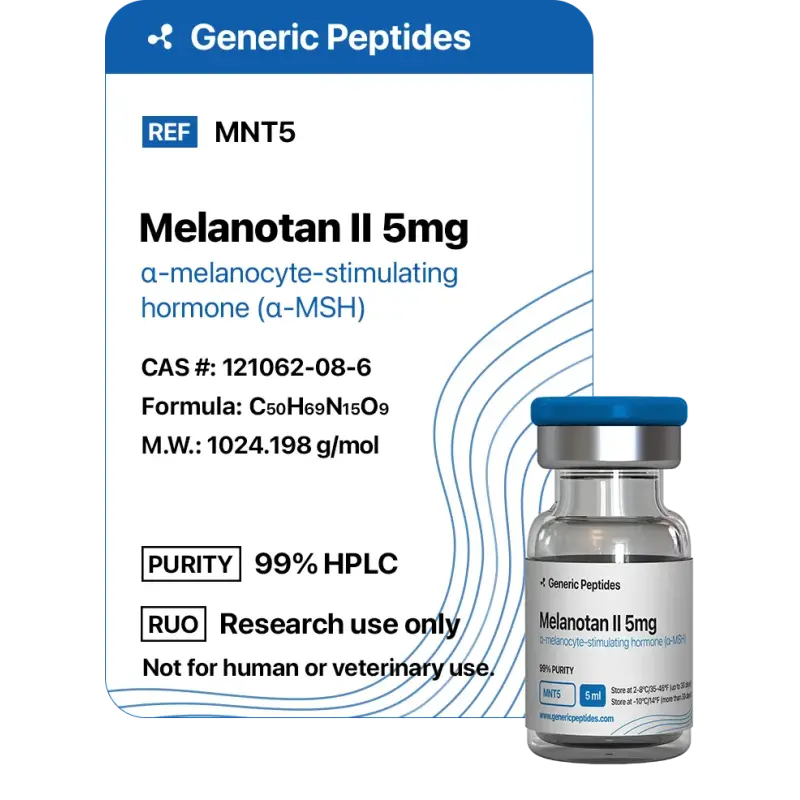
Melanotan II is a cyclic peptide modelled on alpha-melanocyte stimulating hormone, written Ac-Nle4-Asp5-His6-D-Phe7-Arg8-Trp9-Lys10 alpha-MSH4-10-NH2, and sold by Generic Peptides as 5 mg and 10 mg vials of freeze-dried powder. It binds melanocortin receptors without discrimination, meaning it switches on the MC1 receptor responsible for pigment production and the MC3 and MC4 receptors that control appetite, flushing, nausea and erectile signalling at the same time.
That lack of selectivity is the whole story of the product. A molecule that only darkened skin might have become a tanning drug; one that also causes nausea, facial flushing and spontaneous erections was never going to be sold over a counter, and pharmaceutical development stopped in 2000. Its metabolic descendant is a different case: bremelanotide, known as PT-141, is essentially the same sequence missing a terminal amide group, and that molecule later won approval for a sexual function indication. The two are related but they do not share a regulatory status.
The human evidence consists of a single phase I pilot study from 1996 with three healthy men. Everything else published is secondary commentary, user report or animal work, and both the Australian regulator and the Skin Cancer Foundation have issued warnings about tanning products built on this peptide.
Dosage Protocol
No approved amount exists, and the only numbers with any scientific origin are the ones from that pilot study. They are reproduced here to show what was done in research, not as instructions.
| Pilot escalation | Began at 0.01 mg per kg under the skin, rising in increments of 0.005 mg per kg to 0.025-0.03 mg per kg |
| Pilot schedule | Injections on weekdays across two weeks in the three volunteers |
| Proposed figure | The authors suggested 0.025 mg per kg for future studies; that is a research note, not a protocol |
| Absorption study | A separate trial used ascending single doses from 0.03 to 1.5 mg per kg to profile safety and kinetics |
| Timing convention | Evening injection, because nausea and flushing arrive soon after the dose |
| 5 mg plus 2 ml | Gives 2.5 mg/ml, so a 10 unit pull holds 250 mcg |
| 5 mg plus 1 ml | Gives 5 mg/ml and a 500 mcg pull at the same mark |
| 10 mg plus 2 ml | Also 5 mg/ml and 500 mcg per pull |
| Female | No female schedule is described in the sources checked |
Bacteriostatic water is added down the side of the vial and the powder is dissolved by gentle rolling. The dry cake is stored at 2-8 C away from light, the solution also cold, and neither should be frozen. For context on the pilot figures, 0.025 mg per kg in an 80 kg person is 2 mg, which is 0.4 ml of a 5 mg/ml solution. That arithmetic is a reading of a three person study, and nothing more.
Suggested Protocols
No controlled work combines this peptide with anything else sold here, so the groups below are shelf comparisons. The first covers the skin and redox products people ask about in the same conversation, the second the melanocortin relative, and the third the neuropeptides that share its side effect profile of flushing and drowsiness.
What to Expect
- Nausea and flushing within the hour. These were reported at most dose levels in the pilot study, and they are the first thing a new user notices.
- Erections well after the injection. The complex of stretching and yawning coincided with spontaneous erections felt one to five hours after dosing, which is the MC4 receptor at work.
- Drowsiness at higher amounts. At 0.03 mg per kg one of the two subjects developed grade II sleepiness and fatigue, a measurable event rather than a complaint.
- Pigment arriving late. Increased colour on the face, upper body and buttocks was noted a week after the course finished in two of the participants.
- Moles change, and that is the serious part. Reversible darkening of existing freckles and moles and the appearance of new ones are reported, which makes skin checks and photographs mandatory rather than optional.
- The melanoma question is open. Reviews connect reported cases mainly to heavy sun exposure and sun-seeking behaviour, and a direct contribution from the peptide cannot be ruled out.
- No approval anywhere. No regulator has licensed the peptide, and the absence of a dose is a consequence of that, not an oversight.
Side Effects and Management
Most of what follows comes from the one pilot study, from dermatological case reports and from user accounts, none of which is a substitute for a monitored trial.
Post-Cycle Therapy
There is no hormonal axis to restart after this peptide, so a conventional recovery plan does not belong here. The effects that need attention are dermatological and cardiovascular, not endocrine.
Two regulatory notes finish the card. Australian authorities warn that tanning products containing this peptide are not approved and that their contents are unreliable, and the Skin Cancer Foundation has asked people not to use it at all. In sport it is not named on the prohibited list, but as an unapproved substance it falls inside class S0, so the ban is more likely to apply than not. For the approved relative with a defined dose, see PT-141. Readers who arrived here from the skin and tissue side of the catalogue should note that BPC-157 and TB 500 belong to a completely separate line of research and have no relationship to pigmentation at all.