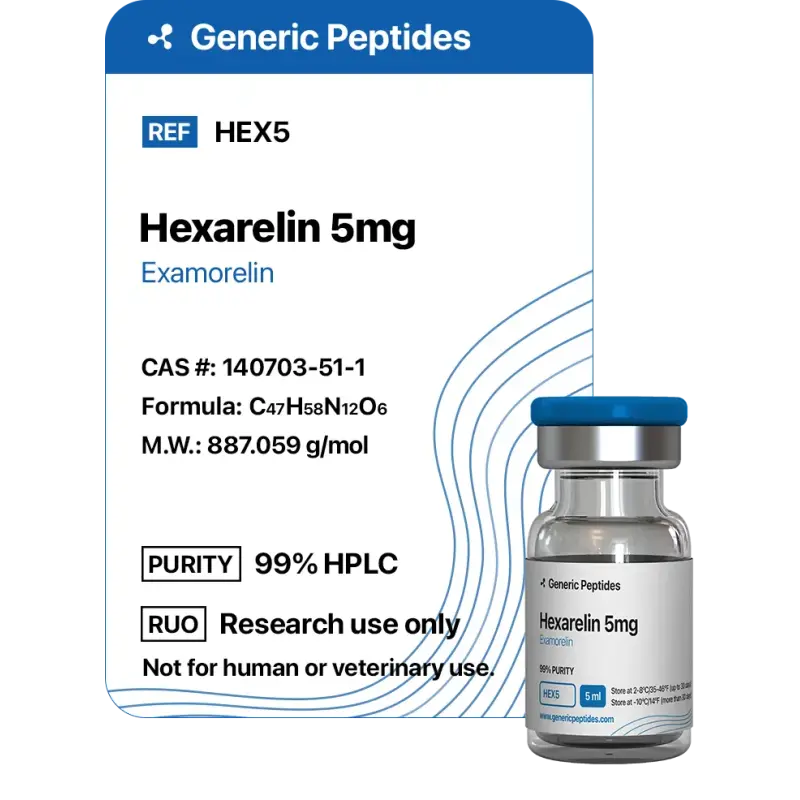
Product Overview
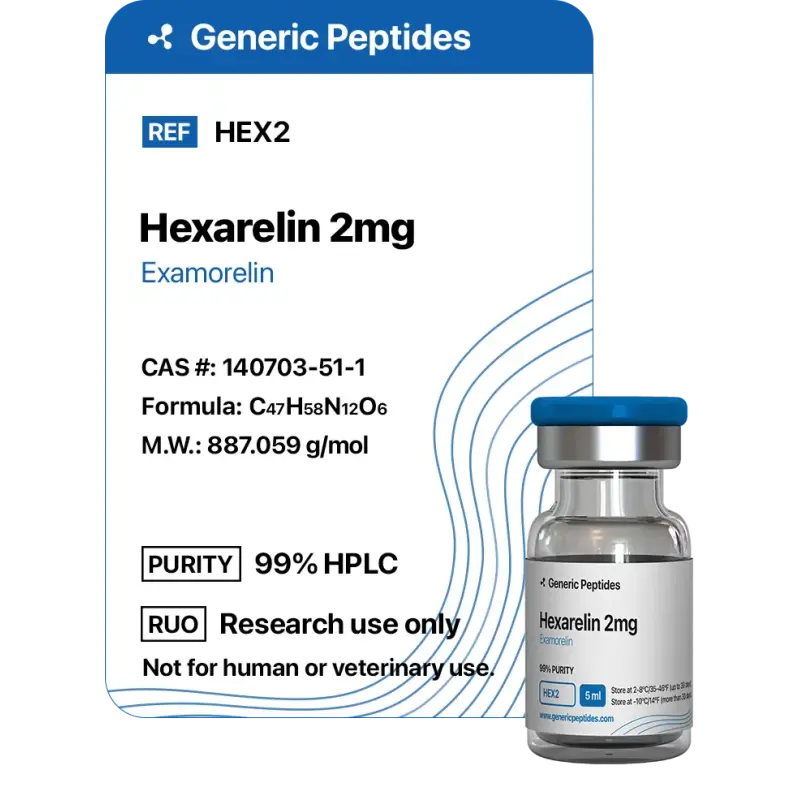
Hexarelin is a growth hormone secretagogue built from seven residues, sold under the international name examorelin and carrying the historical development codes EP-23905 and MF-6003. Generic Peptides lists it as a 2 mg and a 5 mg freeze-dried vial, both for laboratory use.
Its reputation within the peptide family comes from two contrasting facts. It provokes one of the largest growth hormone responses of any ghrelin-receptor peptide, and it stops doing so quite quickly. Repeated exposure is followed by a measurable fall in response, described in the sources as a loss of 50 to 75 percent of effectiveness over weeks to months. A block is therefore treated as a burst rather than a habit, and a rest period of six to eight weeks is standard in vendor material.
The compound also touches the stress axis. Prolactin, ACTH and cortisol all rise slightly and dose-dependently, visible even at modest amounts, which is the line between it and Ipamorelin. Its effect on IGF-1 is genuinely unsettled: some papers report no rise at all, others a small one. Growth hormone peptide work pairs it with a GHRH analogue such as CJC-1295 No DAC, because the two act on different receptors. In sport it belongs to class S2 and is prohibited at all times.
Dosage Protocol
There is no approved dose for a person. Everything below is vendor convention and the arithmetic of the vial, and no separate female schedule appears anywhere in the sources.
| Item | Figure | Basis |
| Research amounts | 100-200 mcg per injection | Vendor convention, not an approved dose |
| Daily pattern | Once or twice, empty stomach | Food blunts the release, hence the timing rule |
| Block length | 4-6 weeks | Desensitisation sets the ceiling |
| Rest period | 6-8 weeks | Longer than the block itself |
| Female | No confirmed protocol | Nothing found in the sources checked |
Vial arithmetic is short. One millilitre into the 2 mg vial gives 2 mg per millilitre, where a tenth of a millilitre is 200 mcg. That same vial diluted with 2 ml halves the strength, so a tenth carries 100 mcg. The 5 mg vial with 2 ml sits at 2.5 mg per millilitre, which puts 250 mcg in a tenth. At the research amounts above, a 2 mg vial lasts about 20 days and a 5 mg vial about 50 days.
Suggested Protocols
Because the two peptide families use separate receptors, a ghrelin-side compound and a GHRH-side compound are normally read as one pairing rather than alternatives.
Supporting material rather than partners: Tesamorelin for the stabilised GHRH route, IGF-1 LR3 for the growth factor downstream of the pituitary, and Somatropin for the finished hormone. Continuous use makes no sense with a peptide that loses half to three quarters of its effect when run long.
What to Expect
- A strong surge, then quiet. Growth hormone climbs within the hour after a subcutaneous shot, and in comparative work hexarelin exceeded GHRH on its own.
- Synergy is reported with a GHRH partner. Two receptors mean a larger combined release than either peptide produces alone.
- The stress hormones move. Prolactin, ACTH and cortisol rise slightly and in proportion to the amount, which is visible early rather than only at high amounts.
- IGF-1 findings disagree. Some work shows no change, some a modest lift, so nobody should count on a big IGF-1 shift.
- Appetite rises, but less than on GHRP-6. Hunger is part of the ghrelin family, though not the headline here.
- Effectiveness drops with repetition. A fall of 50 to 75 percent over weeks or months is why long blocks are called pointless.
- No market, no approval. Development halted at phase II, and the vial is research-grade material.
Side Effects and Management
Two issues dominate: the hormonal traffic through the stress axis and the loss of response that comes from running it too long.
Post-Cycle Therapy and Recovery Windows
No hormonal recovery protocol applies. Testosterone production is never suppressed, so tamoxifen and clomiphene have nothing to restore. What follows a block here is a rest window long enough for the pituitary to answer fully again.
Powder storage is 2 to 8 C in the dark. Once mixed, the solution stays in the refrigerator for roughly 28 to 30 days, is never frozen, and a cloudy mix should be discarded rather than used.