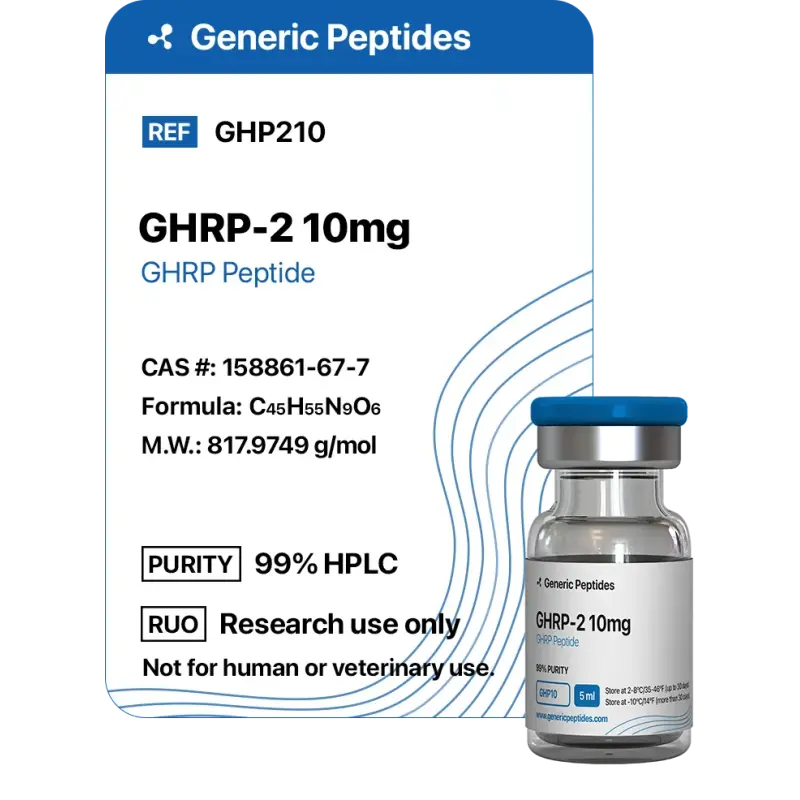
Product Overview
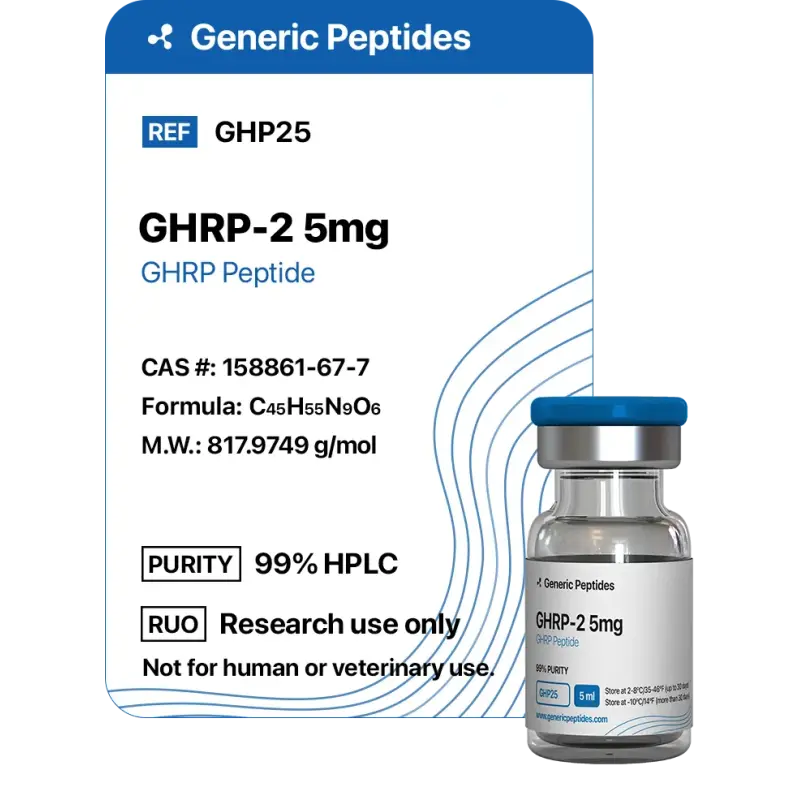
GHRP-2 is a short chain of six amino acids, filed under the international name pralmorelin, while older development papers list the codes KP-102 and GPA-748. It works at the ghrelin receptor, the same switch the stomach uses to signal hunger, rather than at the GHRH receptor that defines the other half of growth hormone peptide research.
Generic Peptides offers it in 5 mg and 10 mg lyophilised vials. Both are laboratory material. The only approved form anywhere is a Japanese diagnostic product given once, under supervision, at 100 mcg intravenously to test whether a pituitary still responds. Nothing about that test translates into a schedule for a vial. GHRP-6 is its closest relative on the same shelf, and the two are separated by appetite strength rather than by class.
Two numbers set expectations. The half-life after an intravenous dose runs from 25.2 to 41.4 minutes, so nothing accumulates: the pituitary response peaks and dissolves within about an hour. The second number is hormonal. Unlike Ipamorelin, which was designed to spare the stress axis, this peptide pushes ACTH and cortisol upward as well. In sport it sits in class S2, prohibited at all times, with no published detection window for the peptide form.
Dosage Protocol
The sheet below is arithmetic and research convention, not a prescription. No unified human protocol for the vial exists in the sources, and the approved diagnostic test is a single supervised shot rather than a course.
| Item | Figure | Basis |
| Diagnostic reference | 100 mcg intravenously, once | Japanese approved test; secondary sources, primary label not verified |
| Research timing | Split shots, often before sleep | Convention, not a confirmed protocol |
| Course length | Short blocks | Frequent injections raise the load on the stress axis |
| Female | No confirmed protocol | Sources checked describe none |
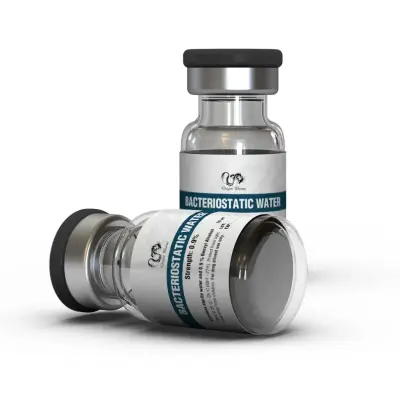
| Route | Subcutaneous | Reconstituted with bacteriostatic water |
Dilution decides how finely the research amounts can be divided. Mixing the smaller vial with 2 ml of bacteriostatic water yields 2.5 mg in every millilitre, so each tenth of a millilitre carries 250 mcg, which reads as 10 marks on a U-100 barrel. The larger vial with the same 2 ml doubles that figure to 500 mcg per tenth, and with 5 ml it lands back on 200 mcg per tenth. Since the peptide clears inside an hour, how often a shot is given counts for more than how large it is.
Suggested Protocols
Growth hormone peptide work is built on receptor pairing. A ghrelin-side peptide and a GHRH-side peptide act through different doors, so combining them is the standard laboratory pattern rather than a stack in the bodybuilding sense.
The wider peptide shelf is mostly supporting material rather than partners. Tesamorelin and Hexarelin cover the stronger end of the GHRH and ghrelin families, while Somatropin represents finished growth hormone rather than a signal to make it. Continuous long blocks are described as pointless with such a short-acting peptide, since the blood level is back near baseline within an hour of each shot.
What to Expect
- The spike is brief. Growth hormone rises immediately after the shot and fades within roughly 60 minutes, matching the 25 to 41 minute half-life.
- Hunger is reliable. Increased appetite and food intake are documented human effects of the peptide, not a side note, which makes timing around meals matter.
- The signal is broader than selective peptides. ACTH and cortisol both climb, and reviews treat that as the dividing line between this molecule and ipamorelin.
- Fluid and joints can react. Retention and joint discomfort are described for the secretagogue class, though statistics for this peptide alone were not found.
- The development story is thin. Phase 2 work in growth hormone deficiency and short stature never produced a marketed product, which the sources link to a weaker rise than expected in deficient patients.
- Frequency drives the load. Because each shot is short, repeated daily injections accumulate pressure on the stress axis.
- Sport use is prohibited outright. Class S2 applies whether or not the product is labelled for research.
Side Effects and Management
Most of what users notice is either hunger or the stress-hormone response, and both scale with how often injections are given rather than with a single large amount.
Post-Cycle Therapy (Not Applicable)
The gonadal axis is not involved. This peptide asks the pituitary for growth hormone; it does not shut down testosterone production, so a SERM-based recovery plan answers a question nobody asked.
Keep the powder refrigerated between 2 and 8 C and out of the light. Once reconstituted, the solution keeps for roughly 28 to 30 days under refrigeration and should never be frozen.