Best Anabolic Steroids

Press Enter to search the full catalog.

US Domestic discreet shipping
Third-party batch tested
HPLC & MS verified purity
Trusted Anabolic Manufacturers Only
US Domestic discreet shipping
Third-party batch tested
HPLC & MS verified purity
Trusted Anabolic Manufacturers Only
Back to all products
Duo-Blend CJC and Ipamorelin - Generic Peptides

Generic Peptides

Duo-Blend CJC and Ipamorelin - Generic Peptides

Injection · 5 mg · vial

In stock · ships within 24h Out of stock Ships from International · U.S Domestic
CompoundCJC-1295 no DAC + Ipamorelin
ClassGHRH plus ghrelin peptides
Half-life30 minutes plus 2 hours
DetectionWADA S2, prohibited
Liver toxicityLow, not confirmed
Water retentionLow to moderate
A single 10 mg freeze-dried vial that documents both peptides by weight: 5 mg of the DAC-free releasing-hormone analogue beside 5 mg of the selective ghrelin-agonist secretagogue, a clean 1:1 split. Two receptors, two rhythms, one powder. The releasing-hormone arm runs about 30 minutes after a subcutaneous shot and the secretagogue arm about 2 hours, so the blend is worked in repeated small doses rather than a weekly one. One pack, no solvent included, and no approved dosage form or published human study of the fixed mixture.
Shipping

Not available in this combination

Duo-Blend CJC and Ipamorelin - Generic Peptides
Order Now, Ships Today
$91.00
2
Quality First

All products are manufactured under strict quality standards and independently tested before release. By purchasing, the buyer agrees to use these products in compliance with all applicable laws.

Product Overview

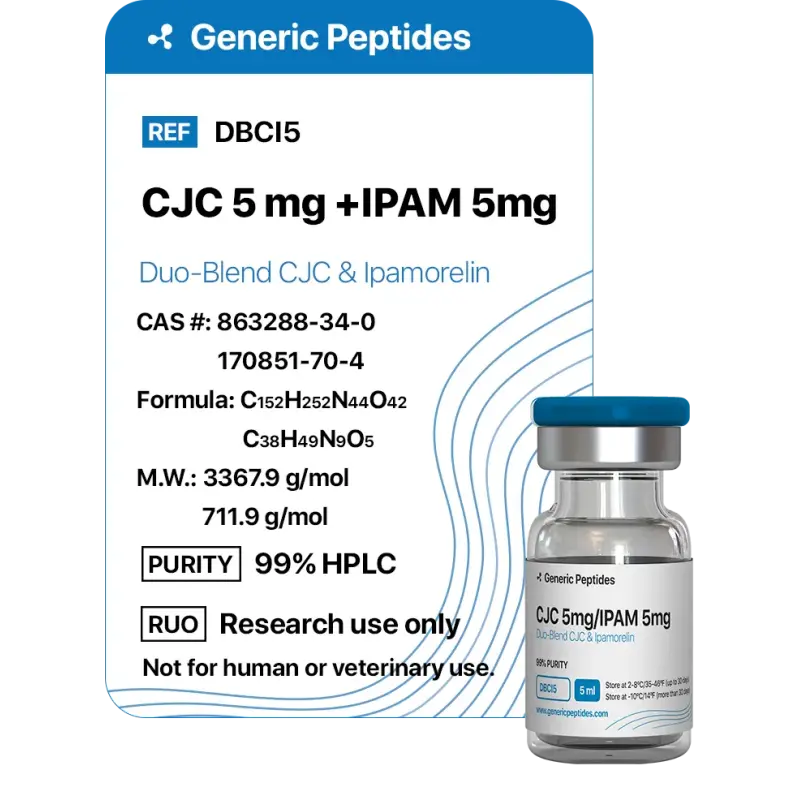
Generic Peptides labels this pack Duo-Blend CJC 5 mg / IPAM 5 mg, and the label is specific: one freeze-dried vial that carries 5 mg of CJC-1295 without DAC next to 5 mg of ipamorelin, 10 mg of peptide in total. The split is documented product data rather than a guess, which matters because every dilution figure below leans on it. The powder needs a solvent before use and the pack does not contain one.

The two halves knock on different doors. The CJC arm is the Mod GRF 1-29 sequence, a GHRH analogue that readies the pituitary, and ipamorelin is a selective secretagogue acting at the ghrelin receptor. Putting a releasing-hormone signal and a ghrelin signal in one syringe is the standard rationale for the pairing, and ipamorelin is the chosen partner because the literature describes it as leaving cortisol and prolactin alone. Each half also exists on its own in this section: CJC-1295 No DAC for the releasing-hormone side and Ipamorelin for the secretagogue side.

The missing drug affinity complex is what defines this vial. That anchor lets a peptide ride on albumin and spreads its activity across days, and the anchored molecule is a separate product, CJC-1295 DAC. Take the anchor away and the releasing-hormone arm lasts minutes instead of days, so a single daily injection cannot hold a signal steady. No approved form of this fixed blend exists and no published human trial of the mixture was located, so the page stays with dilution arithmetic and research conventions.

Fixed 1:1 Ratio and Dilution

With both arms documented at 5 mg, a mixed vial can be read as two numbers at once: total peptide in the syringe and the amount belonging to each half. The table gathers the vendor arithmetic and the amounts recorded for each half separately in research writing. It is a calibration aid, not a schedule.

Item Figure Comment
Vial content CJC-1295 no DAC 5 mg plus ipamorelin 5 mg 10 mg of peptide in total, 1:1 by weight
Solvent Bacteriostatic water Run it down the glass wall and swirl; shaking damages peptides
Two millilitres added 5 mg per ml A 10 unit draw of 0.1 ml carries 500 mcg of mixture
Five millilitres added 2 mg per ml The same 10 unit draw now carries 200 mcg
Per arm, 5 mg per ml 250 mcg each half Half of the 500 mcg draw belongs to each peptide
Per arm, 2 mg per ml 100 mcg each half Half of the 200 mcg draw belongs to each peptide
CJC arm in research writing 100-200 mcg per injection DAC-free version only; the anchored molecule is a different pack
Ipamorelin arm in research writing 200-300 mcg, 2-3 daily Frequency dictated by the roughly 2 hour half-life
Timing Empty stomach About two hours after food; the pre-sleep dose is the usual placement
Block in vendor writing 12-16 weeks plus 4 off Borrowed from the ipamorelin protocol, not from blend data
Female Not confirmed The sources list no female amounts for the blend

Two readings trip buyers up on a mixed vial: the total in the syringe and the share belonging to each half. At the stronger mix a 10 unit draw is 500 mcg split into 250 mcg per arm, and at the weaker mix the same draw is 200 mcg split into 100 mcg per arm. Neither reading is a recommendation; both are arithmetic that follows from the 1:1 label and the volume of water added.

The powder keeps best cold, dark and sealed at 2-8 C, and the mixed vial is a perishable item. Vendor convention for this peptide family quotes roughly 28-30 days at 2-8 C after reconstitution, and the sources give no exact figure for this particular pack, so a batch should be logged with its mixing date. Repeated freeze and thaw cycles of a dissolved peptide are not part of any convention found here.

Two-Receptor Protocols

The layouts below are research arrangements collected from vendor and community writing. No combination was tested against a control, and the fixed blend has no human data at all, so they are described as comparisons rather than routines.

Blend plus finished hormone
Duo-Blend - 100-300 mcg per injection + Somatropin - supplied ready-made
The blend raises the user's own output while somatropin supplies the hormone directly; two points on one axis, and the pairing has not been studied as a unit
Ghrelin shelf cross-check
Duo-Blend - secretagogue arm + GHRP-2 - ghrelin route + GHRP-6 - ghrelin route
Read as alternatives, not additions: all three pull the same receptor, so stacking them adds volume rather than a new pathway
Releasing-rhythm comparison
A rhythm comparison: this blend pulses for minutes, while the anchored analogue holds a level for days and tesamorelin carries the visceral fat data

Anyone comparing releasing-hormone options should put Sermorelin on the same shelf, since it is the older GHRH fragment with the longest clinical record. Users who want a longer window between shots belong with the anchored molecule rather than this vial, and users who want the finished hormone rather than a release signal start further down the pathway.

What to Expect

  • Weeks 1-3: sleep and recovery first. Community and vendor accounts mention easier recovery and better sleep before anything else changes. These are reports, not measurements.
  • Within the hour: the pharmacological event. Growth hormone leaves the pituitary shortly after a dose, but nothing is felt at that speed, so the mixture has to be evaluated across months rather than days.
  • Two or three doses a day are the floor, not a preference. Halves of about 30 minutes and about 2 hours cannot be stretched into one morning shot.
  • Meal timing changes the read-out. Injecting on a full stomach blunts the response, so the empty-stomach rule is part of the method.
  • Months, not weeks, for composition. The 12-16 week block is the shortest window in which anything about body shape is discussed at all.
  • Class complaints arrive as amounts climb. Puffiness, aching joints and aching muscles sit in the general tolerability notes for growth hormone peptides.
  • Where the evidence stops. There is no peer-reviewed human dose for this mixture, and each arm is named in the banned class for tested athletes.

Side Effects and Management

Tolerability information for a fixed blend is thin, so most of what follows is class-level and is labelled that way.

Water retention and puffinessLower the amount per injection or stop the block. A class effect of growth hormone peptides, not a measured figure for this vial.
Aching joints and musclesCut the amount and allow a pause. Class-level reports tie it to the size of the dose.
Appetite arriving after a shotThe ghrelin arm drives hunger, so meals get planned around the injection window. Frequently reported.
Flush or headache soon after dosingGive it slowly and lower the amount. Reported with releasing-hormone analogues and tied to dose size.
Redness or soreness at the siteMove the injection point each time, keep technique clean and mix with bacteriostatic water only. Common in repeated subcutaneous work.
Unknown long-term profileImmunogenicity and extended-use questions are unanswered in the sources. Blocks stay short and observations get recorded.

Pulse Checks and No PCT

The blend raises endogenous growth hormone output and never touches the gonadal axis, so a SERM restart has nothing to fix on this page. What follows a block is measurement and a gap, not a drug.

Why no PCTNo suppression of testosterone production is attributed to either half, so tamoxifen or clomiphene has no target here
Pulse read-outIGF-1 together with growth hormone, used to describe the release profile; no marker is validated for the mixture itself
Metabolic checkGlucose belongs in the panel when growth hormone signalling is pushed over a long block
Between blocksRoughly four weeks off after 12-16 weeks is the convention carried over from the ipamorelin protocol
Testing statusEach arm is named in WADA class S2 and banned at all times; no published detection window exists for the fixed mixture

Anyone who has been running suppressive compounds alongside a growth hormone peptide still needs the recovery protocol for those compounds, and that work belongs with the substances that caused the shutdown rather than with this vial. The blend itself simply ends: taper if the amount per injection is being stepped down, keep recording sleep, joints and appetite, and let the next block start from a clean baseline.
This material is published for educational and research reference purposes only. The compounds described are research-grade materials supplied for laboratory work and are not presented here as medicines or as a treatment for any condition. Dosing information reflects published clinical and reference data for the active substances, not a recommendation or a prescription. Nothing on this page should be read as medical advice. Keep all products out of reach of children and follow the regulations that apply in your country.
What exactly sits inside a Duo-Blend CJC 5 mg / IPAM 5 mg vial?
One freeze-dried vial holding 10 mg of peptide split evenly: 5 mg of the DAC-free releasing-hormone analogue, sold elsewhere as Mod GRF 1-29, together with 5 mg of the selective ghrelin-receptor agonist ipamorelin. The 1:1 ratio is recorded in the product data for this pack. No solvent is included.
Which version of CJC-1295 is in this blend, with DAC or without?
Without DAC. The drug affinity complex is an albumin-binding anchor that stretches activity across several days, and the blend uses the short version instead, and its clearance after a subcutaneous shot is measured in tens of minutes rather than days, so a pulse is what appears instead of a plateau. The anchored molecule is sold as a separate product.
Why is ipamorelin paired with the releasing-hormone analogue instead of used alone?
The two peptides use different receptors, so they are read as complementary signals rather than duplicates: one prepares the pituitary, the other triggers release. Ipamorelin is the common partner because the literature describes it as not raising cortisol or prolactin, which separates it from the older hexapeptide secretagogues.
How is the draw calculated after a 10 mg blend vial is mixed?
Adding 2 ml gives 5 mg per ml, so a 10 unit draw of 0.1 ml holds 500 mcg of mixture, which is 250 mcg of each arm at the 1:1 split. Adding 5 ml gives 2 mg per ml, so the same draw holds 200 mcg, or 100 mcg per arm. The total and the per-arm figure are two readings of one syringe.
How often is the blend injected in research and vendor writing?
The ipamorelin convention is 2-3 injections a day, which follows directly from the half-lives: roughly 2 hours for that arm and roughly 30 minutes for the DAC-free GHRH arm. On an empty stomach, about two hours after a meal, is the usual timing rule. Reported blocks run 12-16 weeks with about four weeks off.
Does the ipamorelin half push cortisol or prolactin upward?
The reason ipamorelin is chosen ahead of GHRP-6 or GHRP-2 is that animal work described it without the ACTH and cortisol rise seen with those hexapeptides. That comparison is animal data, and it has not been confirmed in humans for this fixed mixture, so it should be read as the rationale for the pairing rather than a claim about the vial.
Has the fixed blend been studied in humans, and what do researchers monitor?
No published human study of the fixed combination was found, and no approved dosage form exists for either peptide as a blend. Each half has its own literature. Where the growth hormone axis is characterised, the usual read-outs are growth hormone and IGF-1 for the release profile plus glucose for metabolic tolerance. No marker is validated for the mixture itself.
Is a recovery protocol needed after this blend, and is it banned in sport?
No SERM-based recovery applies, because both halves act on the growth hormone axis and neither suppresses testosterone production. If suppressive compounds were run at the same time, their own recovery protocol still applies. Each arm appears by name in WADA class S2, among releasing factors and secretagogues, banned at all times, with no published detection window for the mixture.

No reviews yet

Be the first to share your experience with Duo-Blend CJC and Ipamorelin - Generic Peptides

Log in to write a review
Duo-Blend CJC and Ipamorelin - Generic Peptides
International

Complete the protocol

Stack it with

View all →
Added to cart